

How To Scientifically Choose The Bridge Gate Machine?
Jul 12, 2023
How To Scientifically Choose the Bridge Gate Machine?
Gantry cranes are widely used in various enterprises due to their simple and reliable structure, convenient installation and strong applicability.
Although the bridge gantry cranes have been developed to the present, including the design, manufacture, installation and other links, the technology is very mature, but some users still report some problems, such as the cranes cannot meet the operation requirements during use, and the crane failures in certain locations are particularly concentrated , There is even no shortage of safety accidents due to improper selection.
In addition to factors such as crane manufacturing quality and installation quality, in many cases, improper selection of cranes is the root cause of equipment reliability and safety reduction.
Therefore, it is particularly important to choose the bridge gantry crane correctly and reasonably.
When choosing a bridge gantry crane, the following points should be mainly considered: the use environment, the condition of lifting objects, work level, space requirements and other special use requirements.
Users can choose lifting machinery after determining the above factors according to their own actual conditions, so as to avoid production inconvenience and safety hazards caused by improper selection of cranes.
According to Article 5 of TSG Q5001-2009 "Management Rules for the Use of Hoisting Machinery", the user should select the corresponding variety (type) of cranes that meet the requirements of the use conditions according to the purpose, frequency of use, load status and working environment of the hoisting machinery. If the selection is wrong, the user shall be responsible.
Combining the relevant standard requirements of cranes and the actual situation of the enterprise, the article specifically analyzes how to choose bridge-gantry cranes scientifically and rationally from the above-mentioned aspects, and provides certain references and references for users to choose crane machinery.
1. Use environment analysis (please click to view more detailed use environment analysis)
When choosing a crane, it is very necessary to understand the crane's use environment. Different use environments have different requirements for the crane as a whole and each mechanism. Environmental factors should be considered mainly: open-air operation, high temperature environment, flammable, explosive and dusty environment, strong wind resistance environment and other requirements.
① Outdoor work
② High temperature environment
③ Inflammable, explosive and dusty environment
④ Strong wind resistance environment
⑤ Other requirements
2. Condition analysis of lifting items
The status of the lifted items mainly refers to the shape and state of the lifted items, which is closely related to the choice of lifting gear. It is necessary to consider whether the suspended object is a whole material or a bulk material, a regular shape or an irregular shape, a solid or a high-temperature liquid, etc.
The user should choose different spreaders according to the shape of the objects lifted by the crane. In general, the hook is selected, and in special cases, grabs, electromagnetic suckers and other special spreaders should be selected according to different materials.
Such as lifting molten metal and molten non-metal, etc., the lifting, turning and other processes should be reasonably designed according to the production process.
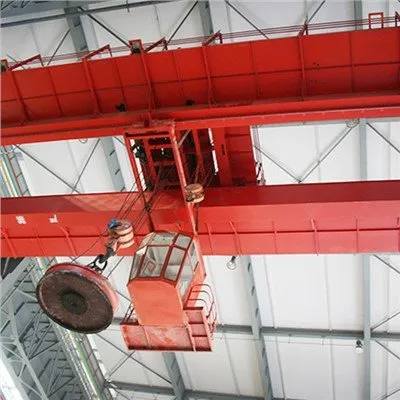
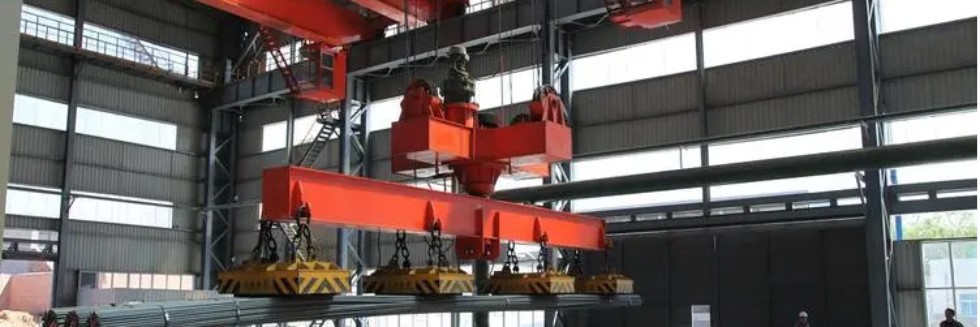
In the refitting of crane spreaders, it is a common application method to use electromagnets to lift metal bulk materials.
Most small and medium-sized enterprises often do not consider the characteristics of lifting materials during the selection process of cranes, but use an additional electromagnet pick-up device to achieve the purpose of lifting metal bulk materials during use. There is serious potential safety hazard in this way of adding.
First of all, the installed electromagnet pick-up device often does not have a backup battery, which cannot achieve the effect of delayed failure of the electromagnet function after the electromagnet is powered off.
Secondly, the installed electromagnet pick-up device does not have a basic current and voltage detection device, so low voltage detection and alarm cannot be achieved.
In addition, when the electromagnet absorbs the material, the material at the lower end cannot be guaranteed to get enough magnetic field effect, and the material will scatter.
Therefore, it is a very dangerous behavior to install an electromagnet pick-up device without permission, and it should be avoided. When purchasing a crane, the needs of material lifting should be considered and a suitable special-purpose crane should be selected.

3. Working level
The working class of a crane is a composite parameter related to load weight and frequency of use. Here, not only the maximum weight of the items to be lifted, but also the weight of the items that are often lifted and the corresponding frequency of use of the two should be considered. The work level is determined according to the load spectrum coefficients that characterize the load state.
When selecting a crane, general enterprise personnel will consider several main parameters such as rated lifting capacity, span, lifting height, lifting speed and running speed of large and small vehicles according to production and use requirements, but it is easy to ignore the requirements of the crane's working level.
Our company has seen many cranes with busy work and heavy loads whose working level is only A3, resulting in concentrated and frequent faults after a period of use, such as faults in operating mechanisms, burnout of drive motors, damage to starting resistors, fatigue damage to parts, etc.
Accurately understanding the meaning of the working level has a non-negligible significance for the selection of cranes. The work level is to consider factors such as the weight of the hoisted items, the busyness of use, and work efficiency. It is mentioned in the introduction of GB/T3811 "Code for Design of Cranes" that crane users should pay special attention when determining crane order requirements and purchasing crane products. Pay attention to determining and selecting the working level of the whole crane and its mechanism.
4. Space requirements
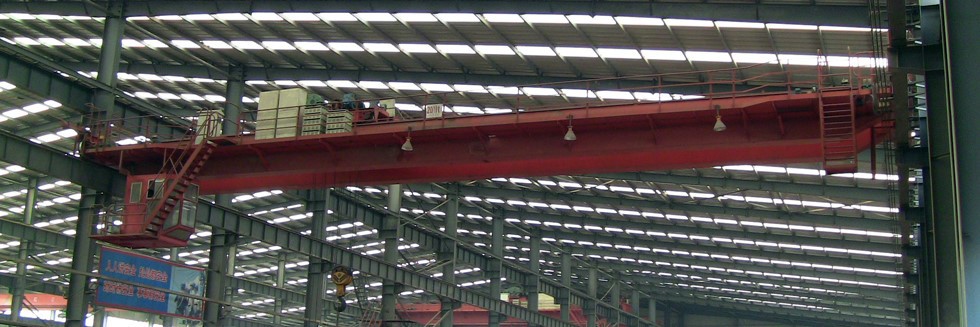
When selecting a crane, it is necessary to consider meeting the requirements of the use site, work space and corresponding maintenance space.
According to the layout of the workshop site, such as the distance from the wall to place heavy objects, the maximum height, volume and weight of the heavy objects, a reasonable selection of cranes can make full use of the workshop space and reduce the occurrence of crooked and inclined cranes. , to reduce the resulting inconvenience and failure.
According to the regulations in GB6067.1, the distance between any part of the crane and any fixed part of the building is not less than 0.5m; the distance from any handrail or guardrail is not less than 0.1m; the distance from any pedestrian passage (except the working platform) is not less than 0.5m; the lower limit of the crane and The vertical distance of the lower passage is not less than 1.7m; the lower limit and the uninhabited part are not less than 0.5m; the vertical distance of the upper limit is not less than 0.5m at the maintenance position, and can be reduced to 0.1m when there is no danger to personnel.
When choosing a crane, it is also necessary to consider the insufficient boundary size caused by the change of the factory building in use. For example, the roof of a wooden factory building deforms more seriously when the weather humidity and temperature change. If the upper boundary size is too small, it will cause interference during operation.
The settlement at both ends of the workshop is more serious, which will also affect the limit size of the crane. In case of a multi-storey workshop, the deformation of the crane rail beam in the upper workshop will be aggravated, which will have a greater impact on the change of the operating space.
In addition, when choosing a crane, the maintenance space of the crane itself should also be considered reasonably.
Lifting equipment belongs to high-altitude equipment, maintenance or failure, there will be situations of high-altitude operations. Nowadays, the majority of crane production and user units tend to ignore this aspect. It is specifically manifested in the most commonly used hoist cranes. There is a lack of maintenance platform at the maintenance point of the electric hoist. There are a series of problems such as the headroom height of the guardrails of the walking platform and the maintenance platform is very small, the safety distance of the safety passage is insufficient, and the maintenance of each operating mechanism is inconvenient.
5. Special use requirements
In the selection process of bridge gantry cranes, due to the actual needs of lifting operations, other special requirements need to be considered, such as positioning accuracy, matching requirements with other equipment on the work site, and the enterprise’s ability to bear risks, and appropriately increase redundancy Design requirements to improve safety, etc.
The selection of cranes is often closely related to the safe use and maintenance difficulty of cranes. When users choose models, they often put cost and price first, while ignoring some hidden performance factors. These are mentioned in the article. The safety factors and performance indicators that should be considered when choosing a crane can be used as a reference. I hope that the majority of users can actually choose a crane that suits their production conditions.