


Deformation Of Main Girder Of Purchased 20 Ton Bridge Crane
Jan 08, 2023
Deformation of main girder of purchased 20 ton bridge crane
After a 20 ton bridge crane has been used for a period of time, it will be found that important components such as bridges and girders are deformed to varying degrees.
The bad phenomenon of the bridge is that the skew difference exceeds a certain range, and the bad function of the main girder is manifested as side bending.
The following is the solution to the side bending problem of the main girder of a 20 ton bridge crane.

Inward bending of main girder of bridge crane:
The deformation is mainly partly tortuous, with traces of bumps. The bending degree of the upper and lower cover plates is different, and the lower cover plate is more severe.
According to the requirements of deflection correction, the heating zone should be set at or near the protruding part of the side bend. At this point, the heating zone can be heated to form a trapezoid in the lower cover.
Thus, the heating triangle of the inner web is larger than the heating triangle of the outer web.
Sometimes, due to the correction of the waveform of the inner web of the main girder, it can also receive the effect of correcting the inner bending of the main girder. In some cases, the part is seriously bent inward, the upper and lower cover plates are also deformed,
and the upper cover plate is even more serious, so the side bend must be repaired separately.
In this case, the upper and lower abdominal plates are heated isosceles. If the inside of the cover plate is severely tortuous, the triangular heating area of the upper cover should be larger.
Because the main beam is not perpendicular to the end beam, the main beam bends inward.
This is actually an angular deformation between the girders and the end girders, and often results in a bridge diagonal that is out of tolerance and thus can be heated outside the ends of the girders.
Because the stiffness of the main beam is much lower than that of the end beam, the angular deformation of the end beam will cause a large bending deformation of the main beam.
At this moment, the heating area of the upper and lower cover plates is still an isosceles triangle, the bottom width B is 60-100mm, and the height h is 100-150mm; the web is heated along the entire height into a strip shape with a width B, and the distance between the heating position and the end beam Not more than 0.5m
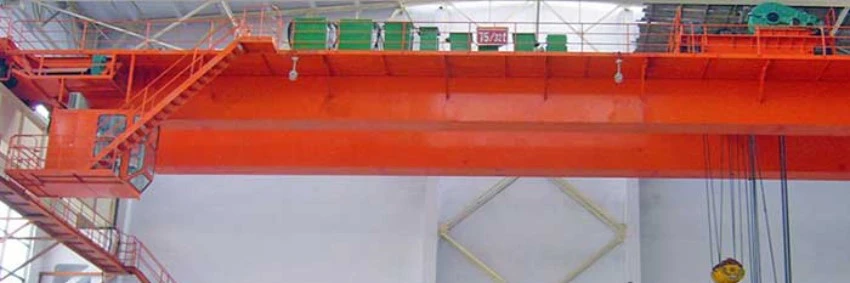
Outward bending of main girder of bridge crane:
The transverse bending of the main beam is mainly caused by improper storage or bumping.
If a small number of side bends do not cause the vehicle to bind, it cannot be repaired because it will gradually move inward after application.
If the outer bending is too large, that is to say, the strip heating zone with a large outer bending position should be selected on the side beam of the walking platform, with a width of 60-100mm, and the entire side beam section should be heated to 700-800 degrees. partial side bend
Especially severe, or large outer bending distance span 3M, proofreading effect is not obvious.
Before flame heating, first cut the channel plate of the protruding part horizontally, use a puller or a manual hoist to straighten the main beam with flame straightening, and then weld the cut part.
At this moment, the pull plate should be welded on the upper and lower cover plates respectively.
Therefore, most of the main beams are bent inwards and should be corrected according to the cause and shape of the deformation.
Side bending can be carried out by correcting the deformation of the end beam (side bending or warping of the end beam), heating the end of the main beam, correcting the deflection of the main beam, correcting the web waveform of the main beam, cutting off the channel plate, etc., which not only requires a lot of work, but also is a new internal stress.


