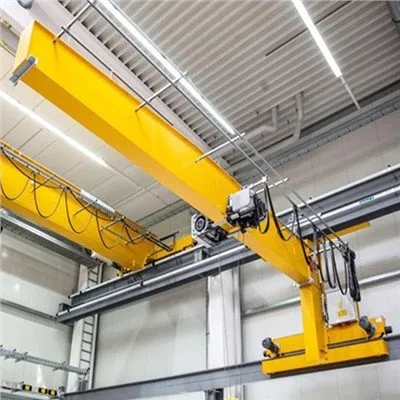
Assembly Of 5 Ton Simple Gantry Crane
Feb 11, 2023
Assembly Of 5 Ton Simple Gantry Crane
1. The concept of assembly
Any piece of machinery and equipment is composed of many parts, a process of combining several qualified parts into components according to the specified technical requirements, or combining several parts and components into machinery and equipment, and making qualified products after adjustment and testing The process is called assembly.
Assembly is the last process in machine manufacturing, so it is the key to ensure that the machine meets various technical requirements. The quality of the assembly work plays an important role in the quality of the product.
2. Assembly process
(1) Preparations before assembly
① Study and be familiar with the technical conditions of the assembly drawing, and understand the structure and parts functions of the 5 ton simple gantry crane, as well as the connection relationship.
② Determine the assembly method, procedure and required tools.
③ Pick up and clean the parts.
(2) Assembly
Assembly can be divided into component assembly, part assembly and general assembly, and the entire assembly process should be carried out in order.
① Component assembly A number of parts are installed on a basic part to form a component. For example, a transmission shaft in a reducer is a component assembled from shafts, gears, keys and other parts.
② Component assembly A component (independent mechanism) is formed by installing several parts and components on another basic part.
③ General assembly The operation process of combining several parts, components, and parts into a whole machine is called general assembly.

(3) Requirements for assembly work
① When assembling, check whether the shape and dimensional accuracy of the parts related to the assembly are qualified, check whether there is deformation, damage, etc., and pay attention to various marks on the parts to prevent wrong assembly.
② No gaps are allowed for fixedly connected parts. The moving parts can flexibly and evenly move in the specified direction under the normal clearance, and there should be no jumping.
③ The contact surfaces of the moving parts (or parts) must be sufficiently lubricated, and if there is an oil circuit, it must be unblocked.
④ There must be no leakage after assembly of various pipes and sealing parts.
⑤ Before the test run, check the reliability of the connection of each component and the flexibility of movement, whether each control handle is flexible and whether the handle position is in a suitable position; before the test run, it should be carried out gradually from low speed to high speed.
3. Typical component assembly method
(1) Assembly of screws and nuts
The assembly of screws and nuts is assembled with threaded connections, which are widely used in machine manufacturing. It is easy to assemble and disassemble and replace, and it is easy to assemble and disassemble many times. Precautions in screw and nut assembly:
① The thread fit should be able to be screwed in freely by hand. If it is too tight, the thread will be bitten, and if it is too loose, the thread will break after being stressed.
② The end face of the nut should be perpendicular to the axis of the thread so that the force can be evenly applied.
③ When assembling a group of screws and nuts, in order to ensure uniform force on the mating surface of the parts, they should be tightened according to certain requirements, and should not be fully tightened at one time, but should be tightened twice or three times in sequence.
④ For threaded connections working under variable loads and vibration loads, anti-loosening safety devices must be used.
(2) Assembly of rolling bearings
The assembly of rolling bearings is mostly a small interference fit, which is usually pressed with a hand hammer or a press during assembly. When the bearing is assembled on the shaft, force should be applied to the end face of the inner ring through the gasket; when the bearing is assembled into the hole of the body, the force should be applied to the end face of the outer ring; The end faces of the inner and outer rings should be pressurized at the same time.
If there is no special pad sleeve, you can also use a hand hammer or a copper rod to knock in symmetrically and evenly along the periphery of the bearing end face, and the force should not be too large.
If the bearing and the shaft have a large interference fit, the bearing can be hoisted into hot oil at 80-90°C for heating, and then assembled while it is hot.

4. Requirements for dismantling work
(1) For the disassembly work of the 5 ton simple gantry crane, the operation sequence should be considered in advance according to the difference in its structure, so as to avoid inversion, or violent dismantling and knocking in an attempt to save trouble, resulting in damage or deformation of the parts.
(2) The order of disassembly should be opposite to the order of assembly.
(3) When disassembling, the tools used must ensure that the qualified parts will not be damaged, and it is strictly forbidden to directly hit the working surface of the parts with a hand hammer.
(4) When disassembling, the loosening direction of the parts must be clearly identified.
(5) The disassembled parts must be placed in an orderly and regular manner, and nested together according to the original structure, and marked on the matching parts to avoid confusion. The screw and long shaft parts must be hoisted to prevent deformation.