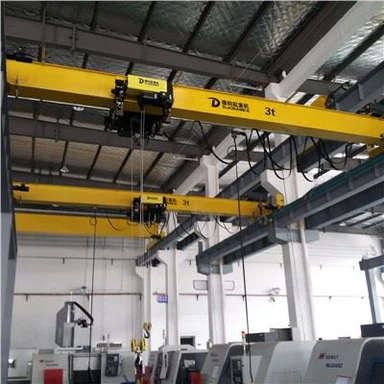
Production Workshop Bridge Crane Notice 1
Jan 24, 2023
Production Workshop Bridge Crane Notice 1

In order to improve the understanding of most customers on bridge cranes and to better serve customers, some common problems and solutions of bridge cranes are sorted out as follows, hoping to bring you help. If you encounter difficult problems , please feel free to contact us, the designer and after-sales service team of Dejun Lifting can help you solve it.
The editor of this article will explain the common problems of the bridge crane's hook, wire rope, drum and wire rope pressure plate.
1. Hook

The hook is the most used pick-up device for bridge cranes. It bears all the loads for lifting. During use, once the hook is damaged and broken, it will easily cause major accidents.
The reason for the damage and fracture of the hook is that the hook is cracked, deformed, damaged and broken due to friction and overload.
In order to prevent the failure of the hook, it is strictly forbidden to overload the lifting during use. During the inspection process, attention should be paid to the opening of the hook and the wear of the dangerous section. At the same time, the hook should be annealed regularly. If cracks are found, it should be scrapped according to GB10051-88, and the hook should not be repaired by welding.
The inspection of the hook by the special equipment management personnel shall judge whether the hook can be used according to the requirements of GB10051-88.
2. Wire rope failure analysis

During the operation of the steel wire rope, the stress of each steel wire rope is very complicated, because the position of each steel wire in the rope is different, some are in the outer layer, and some are in the inner layer.
Even under the simplest tensile force, the force distribution between each steel wire rope is different. In addition, when the steel wire rope goes around the coil and pulley, bending stress, extrusion force between steel wires, etc. are generated, so the force is accurately calculated. It is more difficult, and the static calculation method is generally used.
The maximum static tension in the wire rope should meet the following requirements:
Pmax≤Pd/n where:
Pmax——The maximum static stress that the wire rope can bear during operation;
Pd - the breaking stress of the wire rope;
n - safety factor.
Pmax=(Q+q)/(aη) where:
Q——The rated lifting capacity of the crane;
q - the weight of the hook group;
a - the total number of rope branches carried by the pulley block;
η——The total efficiency of the pulley block.
The formula for calculating the maximum allowable working tension of the wire rope is:
P=Pd/n where:
P——Rated maximum static stress during wire rope operation
P≥Pmax is safe. It can be seen from this that the main reason for the breakage of the wire rope is overload, and it is also related to the number of windings on the pulley and drum. Every time the wire rope is wound, it will change from straight to curved and then from curved to straight. The more the number of windings It is easily damaged and broken; secondly, the breakage of the wire rope is related to the diameter of the pulley, the drum, the working environment, the type of work, and the maintenance situation.
Precaution
① The lifting capacity of the crane should not exceed the rated lifting capacity during operation.
② The wire rope of the crane should be selected according to the type of work and the environment.
③ The steel wire rope should be lubricated regularly (determine the lubrication period according to the working environment).
④ Do not subject the wire rope to sudden impact when the crane is operating.
⑤ Wire ropes in environments with high temperature and corrosive media must have isolation devices.
3. Drum and wire rope pressing plate

The reel is an important stress-bearing part of the crane. During the use, the drum wall will be thinned, holes and fractures will occur.
The cause of these failures is that the drum and the wire rope are in contact with each other and rub against each other. When the drum is thinned to a certain extent, it breaks because it cannot withstand the pressure exerted by the wire rope.
In order to prevent the mechanical accident of the reel, according to the national standard, the wall of the reel should be replaced in time when the wear of the wall reaches 20% of the original or cracks appear.
At the same time, pay attention to the sanitation of the operating environment and the lubrication of the reel and wire rope.