


Crane Travelling
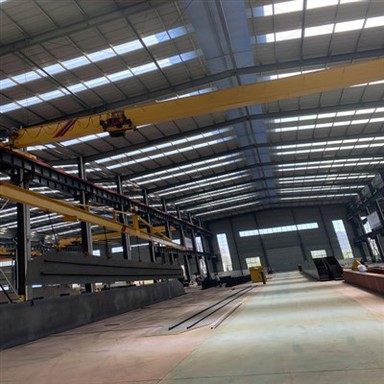
The double girder overhead crane travelling machine is composed of main beam, transverse moving mechanism, long moving mechanism and electrical equipment. According to the different frequency of use, it is divided into three levels of work. A5, A6, A7, A8. It is widely used in steel mills, construction industry, warehouses, freight yards, cement plants and other heavy works.
- Fast Delievery
- Quality Assurance
- 24/7 Customer Service
Product Introduction
1. Product Introduction:
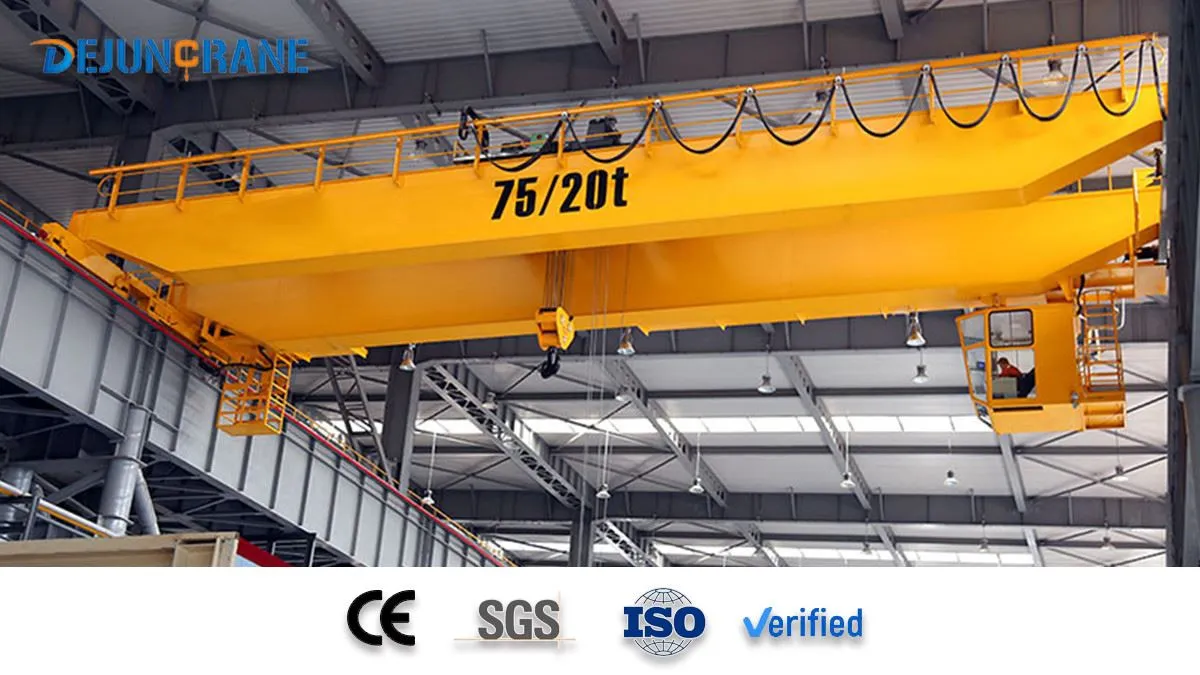
The double girder overhead crane travelling machine
The double girder overhead crane travelling machine is composed of main beam, transverse moving mechanism, long moving mechanism and electrical equipment. According to the different frequency of use, it is divided into three levels of work. A5, A6, A7, A8. It is widely used in steel mills, construction industry, warehouses, freight yards, cement plants and other heavy works.
It depends on the longitudinal movement of the bridge along the workshop track direction, the transverse movement of the trolley along the main beam direction and the lifting movement of the hook to work. With a maximum lifting weight of up to 350, it fulfills most customer requirements.
We design and manufacture custom cranes according to our customers' specifications. When you order a crane from us, please tell us your requirements and your usage details, we will be the one to make sure that we provide something exactly as you require. Our components are designed according to the lifting time of the crane and can be adjusted freely, so you can always rely on the function of the crane.
2. Component:
The hoisting action of the crane, the operation of the trolley and the operation of the trolley work together to form a three-dimensional space, so that the material can be hoisted to any position in the hoisting workspace.
The trolley runs left and right on the girder, which is mainly used to move the lifted weight to a more precise position. The operation of the trolley is the same as that of the cart, but the directions that can be run are different. The running directions of the trolley and the cart are just perpendicular to each other.
The main hook, which has the following characteristics: large lifting capacity and slow lifting speed. Most of the work of the crane is done by the main hook, especially when lifting heavy materials. After the rated lifting capacity of the auxiliary hook is exceeded, it can only be lifted by the main hook for safety reasons.
The auxiliary hook plays an auxiliary role and can also be used to lift heavy objects alone. The lifting speed is faster than the main hook, which can improve the lifting efficiency of light goods. But the lifting weight is lower than the main hook, about 1/5~1/3 of the main hook. Generally, it is a better choice to use the auxiliary hook when the hoisting weight is relatively light and the speed requirement is relatively high.
3. Applicable Environment:
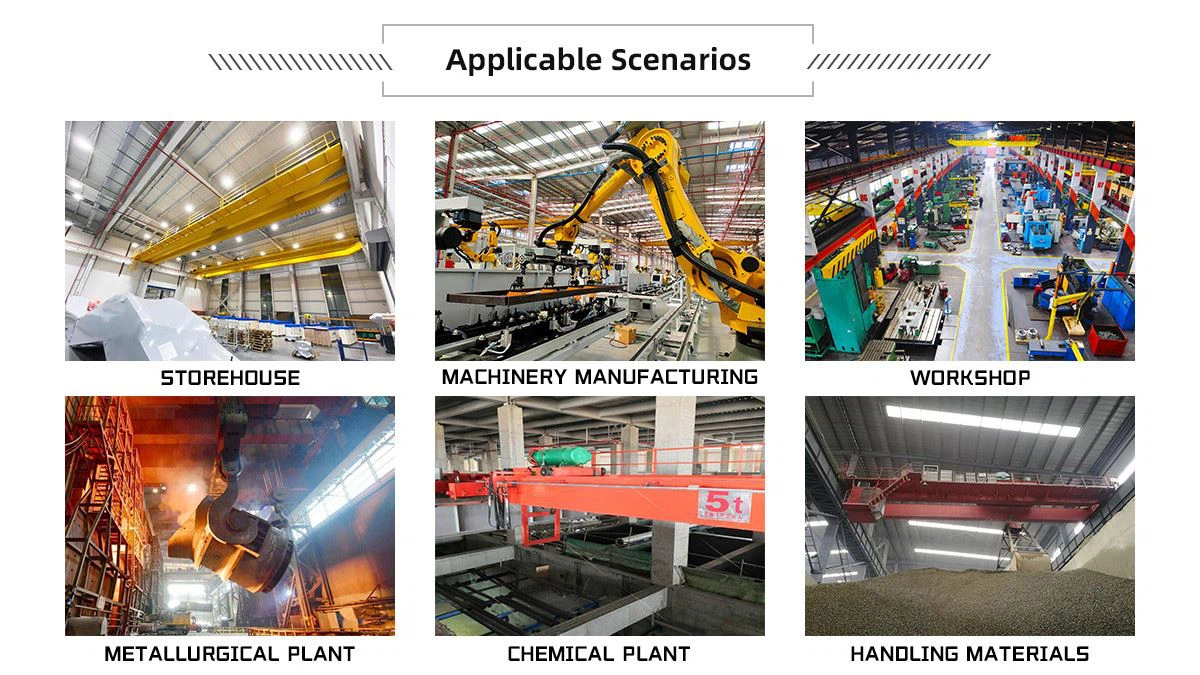
The double girder overhead crane travelling machine is suitable for lifting work in machining, assembly workshops, metal structure workshops, metallurgy and foundry workshops and various warehouses;
In addition to being suitable for the loading, unloading and handling of ordinary heavy objects, the double-girder overhead crane can also be equipped with a variety of spreaders for special operations.
Crane working class: A5 crane (used for less frequent work, such as general machining and assembly workshops).
Crane working class: A6 crane (Used for frequent work, such as auxiliary lifting in metallurgy and foundry workshops).
When used in the open air with rain-proof equipment, the total weight and wheel pressure of the outdoor crane will increase by about 5%. The crane is divided into two working systems: intermediate (A5) and heavy (A6) according to the busyness of use. When selecting, the technical requirements such as working system, working environment, temperature and type of power supply should be indicated.
4. Maintenance and maintenance of electrical equipment
In order to ensure that the crane works reliably and safely, a maintenance system for electrical equipment must be formulated. And be familiar with the causes of various equipment failures and methods to eliminate them. The maintenance of main electrical equipment is described below:
1. In order to extend the service life of the crane's electrical equipment, electrical equipment such as resistors, contactors on the control panel, brakes, and electromagnets should always be kept clean to prevent leakage, breakdown, short circuit and other phenomena.
2. Always observe whether the motor's rotor slip ring brushes are in good contact and whether they are worn.
3. Check whether the contacts of the cam controller, contactor, etc. are singed. If this happens, it should be replaced in time or smoothed with sandpaper before use.
4. Check whether the brake electromagnet coil is heating at any time. Is it due to the traction overload of the electromagnet or the working conditions of the brake do not match the characteristics of the coil. Identify and eliminate them.
5. The rust and dirt on the trolley slide rail must be removed at all times to keep the conductive parts in good contact.
5. Transportation:
Shipping way: by sea, air, land, and Express such as DHL, TNT, UPS, FEDEX. We will choose the suitable shipping method according to your requirements.

6.Maintenance and maintenance of machinery and equipment
The following describes the maintenance and upkeep of main components:
1. Lubrication: The quality and life of each mechanism of the crane largely depends on regular and correct lubrication.
Each mechanism of this series of cranes adopts dispersed lubrication and oil pool lubrication, so the oil nozzles and oil pipes must be checked at all times for smooth flow.
The use of lubricating oil (grease) is related to the working characteristics and temperature of the mechanism. Oil or grease with higher viscosity can be used in places with relatively high temperatures.
No. 3 calcium-based grease can be used for the bearings in the large and small wheels and drum bearing seats, gear couplings, hook pulleys, fixed pulleys and other parts. Sewing machine oil can be used for the movable pins of brakes and other control systems. The reducer is lubricated by an oil pool, and the oil level should always be kept not lower than the scale line on the oil dipstick.
2. Steel wire rope: In order to prevent the steel wire rope from slackening and reducing its strength, the spreader group should be prevented from spinning when the lifting mechanism is working.
Wire ropes must be lubricated correctly and on time. Use a kerosene-soaked rag to clean old oil before lubrication. It is absolutely prohibited to use metal brushes or other sharp instruments to clean dirt on the steel rope; it is also absolutely prohibited to use acidic or other highly corrosive lubricants.
As the steel rope is used over time, some of the wires in the steel rope will be worn or broken. Whether the wire rope can continue to be used safely is determined by the number of breaks in each twisting pitch of the wire rope. The so-called twisting pitch of the steel wire rope refers to the length of the number of turns of the spiral on the steel rope equal to the number of strands of the steel rope. Figure 3 shows the winding pitch of 19 steel wires per 6-strand steel rope.
The scrapping regulations for wire ropes are determined based on the place of use, working system and design safety factor.
The working system used in this series of cranes is medium and heavy, the safety factor is ≤6, and the structure of the steel rope is 6×19+1 interlaced type. Therefore, the steel rope should be scrapped when the number of broken steel wires exceeds 12 within any twisting pitch.
For steel ropes used to lift molten metal or red-hot metal, acids, flammable goods and other dangerous goods, when the number of steel wire breaks within one twisting pitch reaches half of the above, it should be scrapped.
If the surface of the steel rope is worn or corroded, and the worn or corroded cross-sectional area is equivalent to the number of broken steel wires specified above, the steel rope should also be scrapped.
3. Spreader group: The spreader is one of the important components of the crane and must be inspected regularly. If the following conditions are found, the hook or its accessory parts should be scrapped immediately and replaced or purchased new parts.
(1) Any cracks, breaks or cracks appear on the surface (welding repair is strictly prohibited).
(2) The wear of the dangerous section of the hook has reached 10% of the original section height.
(3) The dangerous section or tail of the hook is deformed.
(4) Fatigue cracks appear near the undercut groove or transition fillet in the hook tail part.
(5) Any cracks or deformation of nuts or hook beams.
4. Pulley: The main purpose of the pulley is to check the wear of the rope groove, whether the rim is cracked, and whether there is any jamming.
5. Gear coupling: Mainly check its lubrication, sealing and whether there is looseness such as axial displacement. Check the coupling gear wear at least once a year. It should be replaced if the following conditions occur.
(1) There is a fatigue crack on the tooth root.
(2) Gear teeth cracked.
(3) For the coupling of the operating mechanism, when the wear of the gear tooth thickness reaches 20% of the original tooth thickness.
(4) When the coupling of the lifting mechanism wears the gear tooth thickness up to 15% of the original tooth thickness (10% when lifting dangerous goods).
6. Wheels: Conduct comprehensive inspections of wheel components regularly and take the following measures.
(1) When the wheel rim wear exceeds 30% of the original thickness or the rim part is cracked, the wheel should be replaced.
(2) Mutual deviation in the working diameter of the two driving wheels caused by uneven wear. Must not exceed 1/600 of its nominal diameter. If it exceeds this value, the wheel should be polished again, but if the diameter of the wheel is 10mm smaller than the original nominal diameter after heavy vehicle, the wheel should be replaced.
7. Brakes: The brakes of the lifting mechanism should be inspected every shift, and the brakes of the operating mechanism should be inspected no less than once every 2 to 3 days. When inspecting, attention should be paid to: all parts of the braking system should move accurately, and the shaft bolt should not be blocked. The brake shoe fits correctly on the brake wheel, and the lining of the brake shoe should be good. When the brake shoe is opened, the clearance on both sides of the brake wheel should be equal everywhere.
Turn on the current to check the opening of the brake shoe. If abnormality is found, check the electromagnetic coil and electrical circuits.
The operating temperature of the electromagnetic coil must not exceed 85°C
Check braking torque. The brakes of the hoisting mechanism must reliably support 1.25 times the rated lifting capacity. The brakes of the operating mechanism should be able to brake large vehicles and small vehicles in time, but they should not be adjusted too tightly to avoid serious wheel slippage and vibration and impact.
When the brake shoe lining wear exceeds 50%, it should be replaced immediately. The surface of the brake wheel should be smooth and clean, and dirt should be removed regularly with a kerosene rag.
If the brake wheel emits smoke or burnt smell when working, it means that the temperature of the brake shoe and brake wheel is too high (the temperature of the brake wheel should not exceed 200℃). At this time, the gap between the brake shoe and brake wheel must be adjusted. gap and make it equal.
8. Reel shaft: The action principle of the rising limiter is the same, but there are several structural types. Figure 4 shows only one of them. There is another commonly used rising limiter, which uses a worm gear instead of a movable nut and screw rod. A cam is installed on the worm gear shaft. When the worm gear rotates to a predetermined number of turns, the cam pushes the limit switch and cuts off the power supply. When adjusting the rising height, just loosen the two connecting screws of the limiter and remove the limiter. You can see the square tenon end exposed outside the limiter shell. Turn the square tenon end by hand to the circle that needs to be raised. Count the positions, then reinstall and tighten the connecting screws.
Hot Tags: crane travelling, China crane travelling suppliers, manufacturers, factory