

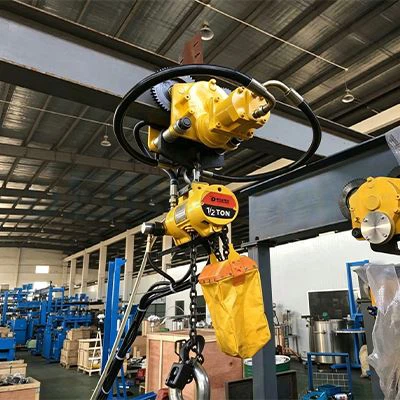
Air Hoist
Loading Capacity: 0.25 to 100 tons (can be customized)
Air Pressure: 4-6 bar
No-load Lift Speed: 1-42 m/min
No-load Drop Speed: 0.95-38 m/min
Brand: Dejun
- Fast Delievery
- Quality Assurance
- 24/7 Customer Service
Product Introduction
Air hoists are special explosion-proof lifting devices powered by compressed air. They mainly use air as the power source to drive air motors and internal mechanical components to lift heavy objects. The principle is gas dynamics. Since they do not require a power supply, they are explosion-proof and generate no sparks. Therefore, pneumatic hoists are widely used in industries such as chemical engineering, shipbuilding, oil storage, oil fields, marine engineering, automotive manufacturing, and mining, where there is a lot of dust, high temperature, and humidity, and flammable and explosive materials. Please keep reading to know more!

Trolley Type Air Hoist

Fixed Type Air Hoist
Air Hoist Specifications
|
Item
|
Pneumatic Hoist
|
|
Loading Capacity
|
0.25 to 100 tons (can be customized)
|
|
Air Pressure
|
4-6 bar
|
|
No-load Lift Speed
|
1-42 m/min
|
|
No-load Drop Speed
|
0.95-38 m/min
|
|
Motor Output Power
|
1-9 KW
|
|
Duct Size
|
13-35 mm
|
|
Chain Size
|
depends on the lifting capacity
|
|
Chain Weight
|
1-21.3 kg/m
|
|
Standard Elevation
|
3 meters
|
|
Controller Standard Rope Length
|
2 meters
|
|
Brand
|
Dejun
|
|
Payment Term
|
TT/LC
|
Features of Pneumatic Hoist
1. The design of the explosion-proof pneumatic hoist fully takes into account the explosion-proof requirements. In terms of structural design, it adopts a spark-free design. The so-called spark-free design means that during the manufacturing process of the pneumatic hoist, the materials and components used are carefully selected to ensure that no sparks are generated when subjected to impact or friction. For example, the drums or pulleys of the pneumatic hoist are usually made of copper, as copper is less likely to produce sparks when rubbed against hard materials.
2. Explosion-proof design of the pneumatic motor. The core component of the pneumatic hoist is the pneumatic motor, which is responsible for converting the energy of compressed air into mechanical energy. To ensure the explosion-proof function, the key components inside the pneumatic motor, such as the blades and pistons, are usually made of aluminum alloy. This material has a lower hardness and friction coefficient, thereby reducing the possibility of sparks due to friction. In addition, the airway design of the pneumatic motor has been optimized to ensure smooth gas flow and further reduce the probability of sparks.
3. Explosion-proof joints and seals. The application of explosion-proof joints and seals in the pneumatic hoist also plays a crucial role. An explosion-proof joint refers to a joint used to connect pipes and equipment that can prevent the leakage of internal explosive gases to the outside. These joints are usually connected with metal threads and use pressure- and corrosion-resistant sealing materials at the connection points to ensure joint sealing performance. Similarly, the seals in the pneumatic hoist are specially designed to maintain good sealing performance under high-pressure and high-temperature conditions, preventing gas leakage.
4. Safety accessories and protective measures. To enhance the explosion-proof performance of the pneumatic hoist, some safety accessories and protective measures have also been incorporated into the design. For example, a safety valve is installed at the air inlet of the pneumatic hoist. When the equipment's internal pressure exceeds the preset value, the safety valve will automatically open to release excess pressure, preventing explosions caused by pressure buildup. In addition, the pneumatic hoist is equipped with an overload protection device. When the load exceeds the rated value, the device will automatically cut off the air supply to ensure the safety of the equipment and personnel.
What Is It Used For?
1. In flammable and explosive environments such as flour mills, chemical plants, and metal polishing workshops, electrical sparks pose a significant hazard. Pneumatic hoists, with their non-electrical and non-sparking characteristics, are the intrinsically safe choice for such settings. When combined with explosion-proof accessories like copper alloy hooks, the risk can be further reduced.
2. In high-frequency and high-load production lines, such as in automotive manufacturing and metal stamping workshops, the continuous operation capability of equipment is crucial. Pneumatic hoists have a simple structure and do not easily overheat, allowing them to work stably for long periods. Test data shows that their maintenance frequency can be reduced to less than one-tenth of that of electric chain hoists, which is of obvious significance for maintaining production line rhythms.
3. In humid and corrosive environments, such as shipyards, port terminals, and electroplating workshops, ordinary lifting equipment is prone to rust. By choosing galvanized chains or 100-level chains, pneumatic hoists can better handle such working conditions and extend their service life.
4. In precision assembly, mold installation, and other scenarios where positioning accuracy is highly demanded, the stepless speed control of pneumatic hoists enables smooth micro-movement operations, avoiding shocks, and is suitable for fine tasks such as engine assembly and glass product handling.

Pneumatic Hoist Applications

Air Hoist For Production Workshop
How To Choose?
When selecting a pneumatic hoist, it is essential to focus on the following factors to match actual operational requirements. First, choose the appropriate rated load capacity based on the weight of the material to be handled. For high-frequency assembly line operations, prioritize models with faster lifting speeds; for precision assembly tasks, opt for low-speed products with better controllability. In mining applications, select products certified with MA/KA safety approvals; for marine use, ensure certification from classification societies such as CCS, and confirm that the explosion-proof rating meets environmental requirements. For confined spaces, prefer compact and lightweight designs; for mobile operations, pair the hoist with a pneumatic trolley. In addition to purchase costs, long-term maintenance costs and downtime losses due to malfunctions need to be considered. Priority should be given to hoist brands with mature structures and readily available spare parts. Moreover, we are a professional hoist manufacturer in China. Besides the air hoists, we also produce and sell electric chain hoists, electric wire rope hoists, and air winches, etc. For any needs, please feel free to contact us!
Finally Words
Due to its unique explosion-proof feature, pneumatic hoists have been widely used in various applications, ranging from the transportation of metal bar materials from the raw material warehouse to the assembly of components on the precision assembly line. For the latest price, please contact us at any time!
Hot Tags: Air Hoist
