What Are The Types Of Cranes?
Apr 23, 2023
What Are The Types Of Cranes?
Hoisting machinery is a mechanical device used for material handling operations. The hoisting machine lifts the material through the combined movement of the working mechanism, moves it within a certain range of space, and then places the material at the designated position as required, returns to the original position with no load, and is ready to work again, thus completing a working cycle of material handling . The handling operation of hoisting machinery is a periodic intermittent operation. Widely used in transportation, loading and unloading and storage and other workplaces.
Modern industrial enterprises require various types of lifting and transportation machinery to meet the needs of enterprise logistics mechanization, and they must effectively use and increase the utilization capacity of equipment to achieve the most economical effect.
In modern production, cranes not only play an important role in the field of material transportation, but also some cranes directly participate in the production process and become the main component of process equipment, which greatly improves labor efficiency and reduces labor intensity.
Lifting equipment has also entered people's work and living fields, such as elevators in public places, large-scale lifting amusement machines in entertainment places, etc., which improve people's life and living quality.
Lifting machinery can be divided into light and small lifting equipment, elevators and cranes according to their structure types.
1. Light and small lifting equipment
Light and small lifting equipment generally has only one lifting mechanism, and the common ones are jacks, electric or chain hoists, winches, and tackles. Some electric hoists are equipped with a running mechanism that can move along a single track.

2. lift
Common lifts include vertical lifts and elevators. Although it has only one lifting mechanism, it is classified as a separate category because it is equipped with complete safety devices and other auxiliary devices, and its complexity is unmatched by light and small lifting equipment.
3. crane
A crane refers to a lifting device that has other moving mechanisms besides the lifting mechanism. According to the different forms of horizontal movement, it is divided into two categories: bridge type crane and jib type crane. In addition, there are cranes with integrated bridge and jib types, for example, cranes with rotatable jibs on loading and unloading bridges, and rotatable trolleys on metallurgical bridge cranes.
1) Bridge type crane. Its characteristic is that the bridge-shaped structure is used as the main bearing member, and the pick-up device is suspended on the lifting trolley that can run along the main girder. The bridge type crane completes the material handling operation in the rectangular three-dimensional space through the lifting movement of the lifting mechanism, the horizontal movement of the trolley running mechanism and the cart running mechanism, and the combined movement of these three working mechanisms. This type of crane is used in workshops, warehouses, open storage yards, etc. Bridge type cranes can also be divided into bridge cranes, gantry cranes and cable cranes according to different structural types.
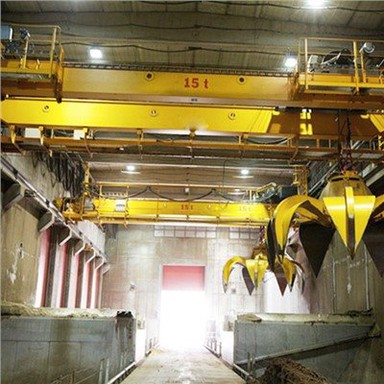
① Overhead crane. It is widely used with single main girder or double main girder bridge crane, its main girder and two end girders form a bridge frame, and the whole crane runs directly on the track of the elevated structure of the building. The simplest is the beam crane, which uses an electric hoist to run on an I-beam or other simple beam.

② Gantry crane, also known as bridge crane with legs. The main girder is supported by two rigid legs or rigid-flexible legs on the ground track to form a gantry that can span the railway track or freight yard, and the cantilever part of the main girder that extends to the outside of the legs can expand the working area . Gantry cranes are sometimes manufactured as single-leg semi-gantry cranes. The loading and unloading bridge is a gantry crane specially used for loading and unloading operations. The supply station, port and other departments carry out the stacking of bulk materials. It is characterized by high running speed of the trolley, large span (generally 60-90m or more), and high productivity ( up to 500~1000t/h or higher). The container gantry crane is a model developed in the 1980s. It is a gantry crane specially used for container stacking and loading and unloading operations, such as a gantry crane for unloading containers on ships.

③Rope crane. It is suitable for cargo yards, reservoirs or construction sites with large spans and complex terrain. Due to the large span, cables fixed to the top of the two pylons replaced the bridge girders. The pick-up device suspended on the lifting trolley is pulled by the traction cable at high speed, and runs back and forth along the load cable. The two towers are respectively on the two sides of the track far apart, and can run at a low speed.
2) Jib type cranes. Its structure has a cantilevered and rotatable arm frame as the main force-bearing member. In addition to the lifting mechanism, there are usually rotating mechanisms and spoke-changing mechanisms. Through the lifting mechanism, spoke-changing mechanism, rotating mechanism and operating mechanism, etc. The combined movement of the four mechanisms can realize loading and unloading operations in circular or oblong spaces. Jib cranes can be mounted on vehicles or other means of transport, constituting a variety of common operating jib cranes, such as portal cranes, tower cranes, railway cranes, and mobile cranes.