How To Prevent The Hook Bridge Crane From Tipping Over?
Jun 25, 2023
How to Prevent the Hook Bridge Crane from Tipping Over?
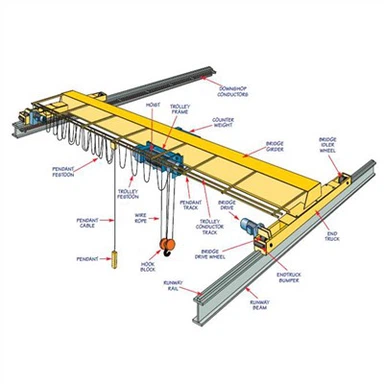
A hook Bridge Crane, Also Known as an Overhead Crane, is a versatile type of machinery using in industrial settings for life.
Essentially, It Consist of a Horizontal Beam that Spans Across A Designated Space, Called A bridge, and one or more hoists that attach to the bridge.
These hoists are used to lift and lower loads while the bridge can move along the length of the area, making it easy to access different locations.
The use of hook bridge cranes is common, and the safety problems brought about by them should not be underestimated, especially the problem of crane overturning, which not only endangers personal safety, but also brings huge economic losses to enterprises. The editor will common The 8 major reasons are sorted out as follows, hoping to bring you some help.

1. The road on which the crane travels must be flat, solid and reliable, and the parking place must be flat. The soft soil layer and the foundation pit should be compacted and reinforced, and the road surface should be flat and solid. If necessary, sleepers, roadbed boxes or thick steel plate tracks should be laid on the moving part of the crane;
2. The slings and rings of the binding components should be calculated, and the lifting tools used should be overhauled and checked regularly, and the damaged ones should be replaced. The binding method should be correct and firm to prevent the sling from breaking or slipping off the component during hoisting, causing the crane to lose weight suddenly and tip over;
3. For vertical and large components, the weight must be checked and the binding must be reliable. Components with unknown weight and loose binding shall not be hoisted to prevent the crane arm from breaking;
4. When lifting components, the sling should be kept vertical, and should not be dragged obliquely beyond the slewing radius of the crane, so as to avoid overloading and wire rope slipping or breaking the rope, making the crane unstable.
When lifting heavy components, pull ropes should be provided. When the crane is vertical, the lifting, lowering and slewing of the boom must be stable, and it must not shake in the air. At the same time, emergency braking or shock vibration should be avoided as much as possible.
Reliable technical measures are not taken, such as adding a balance counterweight at the tail of the crane, pulling the wind rope behind the crane, and without the approval of the relevant technical department, etc., it is not allowed to lift.
It is strictly forbidden to hoist the crane with overload, so as not to accelerate the wear of mechanical parts and cause the crane to tip over;

5. The crane should try to avoid running at full load. When it is full load or close to full load, it is strictly forbidden to perform two actions of lifting and turning (lifting and horizontal movement or lifting and walking) at the same time, so as to avoid uneven roads or inertial forces. , causing the crane to be overloaded, resulting in a rollover accident.
If it is necessary to hang the component for short-distance travel, the component should be turned to the front of the crane, and the height of the component should not exceed 50cm from the ground. Pull the rope well to prevent swinging, and drive at a slow speed;
6. When two hoisting machines are working at the same time, a safe distance of more than 5 meters should be kept between the suspended components of the hooks of the two machines to avoid collision accidents;
7. During the hoisting process, if the operation is interrupted due to power outages or mechanical failures, measures must be taken to deal with it, and the components must not be lifted or suspended in the air;
8. When hoisting, there should be a special person in charge of unified command.
The commanding personnel should be located within the sight of the operator, and can clearly see the whole process of hoisting.
Crane drivers must be familiar with the signals, operate according to the various signals of the commander, abide by the on-site procedures, obey orders and obey the command, and must not leave the post without authorization.
The command signals should be uniformly stipulated in advance, and the signals should be clear and accurate.
|
Lifting Weight(t) |
5 |
10 |
16/3.2 |
20/5 |
32/5 |
50/10 |
|||||
|
Span(m) Customized |
10.5 13.5 16.5 19.5 22.5 25.5 28.5 31.5 |
||||||||||
|
Max. Lifting Height(m) |
Main |
16 |
16 |
16 |
12 |
16 |
12 |
||||
|
|
Aux |
|
|
18 |
14 |
18 |
14 |
||||
|
Hoisting Speed(m/min) |
Main |
3.7 |
3.3 |
3.6 |
2.7 |
2.6 |
1.9 |
||||
|
|
Aux |
|
|
3.8 |
3.7 |
3.7 |
3.37 |
||||
|
Travelling Speed of Crab(m/min) |
9.3 |
10.3 |
10.3 |
10.3 |
9.8 |
8.9 |
|||||
|
Travelling Speed of Trolley(m/min) |
12 |
12 |
12.5 |
12.5 |
12.6 |
12.5 |
12.6 |
12.6 |
12.3 |
12.3 |
|