

Which Power Supply Method Can Be Selected For The 25 Ton Bridge Crane?
Nov 15, 2023
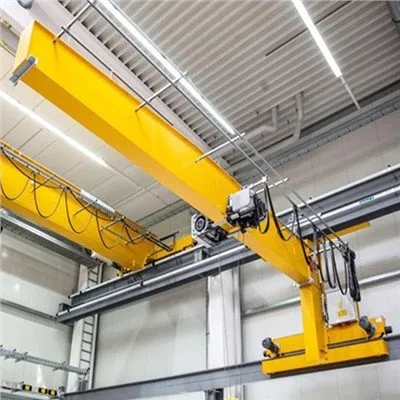
The commonly used power supply methods for 25 ton bridge cranes are divided into two categories, sliding contact line power supply and cable line power supply. Both power supply methods have their own applications. For example, sliding contact wires are very convenient for maintenance and inspection, and occupy a relatively small space. However, they are slightly less resistant to ambient temperature and weather resistance and have poor flexibility; cable wires are It can be continuously bent and used with the equipment, and has better flexibility. Due to the protection of the outer layer of insulating glue, the wear resistance, oil resistance, corrosion resistance, etc. are relatively stronger.

Cables also have round wires and flat wires. Flat wires bend back and forth more times than round cables and have a long service life. According to their characteristics, flat cables are mainly used for mobile laying, while round cables are used for fixed laying. Round cables with small cross-sectional areas can also be used. For mobile laying.

When arranging the cables of the 25 ton crane, it is necessary to ensure that the length of each cable is equal, the pressure plate is pressed firmly, and the outer diameter of the cables on the same layer is as close as possible to avoid excessive stress on one or a small number of cables. The cables that need to be suspended are arranged with a wire harness so that the wires are neat and orderly. During operation, when the distance between two adjacent suspension cable trolleys is such that the angle between the suspension cables is close to 120°, the traction wire rope should be completely straightened and stressed.
When using a cable reel to take up the wire, the cable should be prevented from being worn during movement. For cables with an outer diameter not greater than 21.5mm, the bottom diameter of the cable reel should be at least 10 times the outer diameter of the cable; for cables with an outer diameter greater than 21.5mm , the bottom diameter of the cable drum should be at least 12.5 times the outer diameter of the cable.
The 25 ton crane cable drum should be able to automatically wind up the cable, and the driving torque of the cable drum should not be less than the maximum winding torque required when winding the cable. During the cable laying process, the traction force acting on the cable conductors should be as small as possible. For cables without reinforced cores, the allowable pulling force acting on the copper conductor cross-section is 20N/mm2. For cables requiring high winding speed or heavy cable weight, When the load is heavy, a reinforced wire rope core that can withstand the required traction should be added.

During the application process, some customers also value the advantages of the transmission guide rails of trolley wires, such as good conductivity, fast heat dissipation, and low impedance value. When discussing the crane plan, they will specify that the power supply method uses trolley wires. After we determine the needs and feasibility, , configure the corresponding software and hardware, introduce product features to customers, consider and recommend feasible solutions for customer production value, and the right to choose is in the hands of customers. We not only provide products, but also strive to provide better services.