

What Types Of Lifting Machinery Are There?
Nov 28, 2023
What types of lifting machinery are there?
Among all lifting machinery, according to their structure and performance, they can generally be divided into four categories: light and small lifting equipment, bridge type lifting machinery, jib type crane, and cable crane. Light and small lifting equipment such as: pneumatic hoist, electric hoist, winch, etc. Bridge type lifting machinery such as bridge crane, gantry crane, etc. Boom type cranes such as jib cranes, tower cranes, truck cranes, tire cranes, crawler cranes, etc. Cable cranes such as lifts, etc.
Next is a brief introduction to these crane types. You are welcome to add to the lifting machinery types.

1. Light and small lifting equipment
The characteristics of light and small lifting equipment are lightweight, compact structure, simple movement, and the projection of the operating range is mainly points and lines. Light and small lifting equipment generally only has one lifting mechanism, which can only make a single lifting movement of heavy objects. Belonging to this category are: jacks, pulleys, hand (gas, electric) hoists, winches, etc. Electric hoists are often equipped with a running trolley and a metal frame to expand the operating range.
Electric hoist: CD1 and MD1 series wire rope electric hoists have the characteristics of compact structure, light weight, safety and reliability, high degree of universality of parts, strong interchangeability, high lifting capacity and easy maintenance. They are widely used and popular light lifting hoists. Heavy equipment.
The hoist is available in two types: fixed type and trolley type. It can be installed directly on the frame for use; it can also be equipped with a trolley and installed on the track.

2. Bridge crane
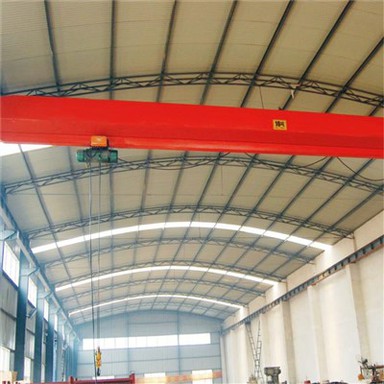
A bridge crane is a bridge type crane with a bridge running on an elevated track, also known as an overhead crane. The bridge frame of the bridge crane runs longitudinally along the tracks laid on the elevated bridges on both sides, and the lifting trolley runs transversely along the tracks laid on the bridge frame, forming a rectangular working range, so that the space under the bridge frame can be fully utilized to lift materials. Hindered by ground equipment.
The characteristic of bridge crane is that it can vertically lift or horizontally transport heavy objects hung on hooks or other fetching devices in space. Bridge crane includes: lifting mechanism, large and small car operating mechanism. Relying on the coordinated actions of these mechanisms, heavy objects can be lifted and transported within a certain cubic space. Bridge cranes, loading and unloading bridges, metallurgical bridge cranes, cable cranes, etc. all fall into this category.
Bridge cranes are widely used in indoor and outdoor warehouses, factories, docks and open-air storage yards. Overhead cranes can be divided into three types: ordinary overhead cranes, simple beam overhead cranes and metallurgical special overhead cranes.
Ordinary bridge cranes generally consist of a lifting trolley, a bridge operating mechanism, and a bridge metal structure. The lifting trolley is composed of three parts: the lifting mechanism, the trolley operating mechanism and the trolley frame.
The lifting mechanism includes motor, brake, reducer, drum and pulley block. The motor drives the drum to rotate through the reducer, so that the wire rope can be wound around the drum or lowered from the drum to lift and lower heavy objects. The trolley frame is a frame that supports and installs components such as the lifting mechanism and the trolley running mechanism. It is usually a welded structure.

The single main girder cantilever gantry crane has a simple structure, is easy to manufacture and install, and has a small mass. Most of the main girder is a deflection box frame structure. Compared with double main girder gantry crane, the overall stiffness is weaker.
Therefore, this form can be used when the lifting capacity Q≤50t and the span S≤35m.
There are two types of single main door beam crane door legs: L-type and C-type. The L-type is easy to manufacture and install, has good stress resistance, and has a small mass. However, the space for lifting goods to pass through the legs is relatively small. The C-shaped legs are made in an inclined or curved shape in order to have a larger lateral space so that the goods can pass through the legs smoothly.

The characteristics of jib cranes are basically the same as bridge cranes. It can operate in circular sites and above, and is mostly used for open-air loading, unloading and installation. There are gantry cranes, floating cranes, mast cranes, wall cranes and deck cranes, etc.
Boom crane includes: hoisting mechanism, luffing mechanism, and rotating mechanism. Relying on the coordinated action of these mechanisms, heavy objects can be lifted and transported within a certain cylindrical space. Boom-type cranes are mostly installed on vehicles or other forms of transportation (mobile) tools, thus forming an operating boom-type rotating crane. Such as truck cranes, tire-type cranes, tower cranes, gantry cranes, floating cranes, railway cranes, etc.
Cantilever cranes come in three forms: column type, wall-mounted type, and balance crane.
A column-type cantilever crane is a cantilever crane composed of a column and a cantilever whose cantilever can rotate around a fixed column fixed on the base, or the cantilever and the rotating column are rigidly connected and rotate together relative to the vertical centerline in the base support. It is suitable for occasions where the lifting capacity is small and the operating service range is circular or sector-shaped. Generally used for loading and transporting workpieces in machine tools, etc.
Column cantilever cranes mostly use electric chain hoists as the lifting mechanism and operating mechanism, while wire rope electric hoists and hand chain hoists are rarely used. Rotation and horizontal movement operations are mostly performed manually, and electric operation is only used when the lifting capacity is large.
Wall cranes are jib cranes that are fixed to a wall or that can operate along elevated tracks on a wall or other support structure.
Wall cranes are used in workshops or warehouses with large spans and high building heights. They are most suitable when lifting operations near the wall are frequent. Wall cranes are mostly used in conjunction with the beam or bridge crane above. They serve a rectangular space near the wall and are responsible for lifting light and small objects. Large objects are borne by the beam or bridge crane.
Balance crane is commonly known as balance crane. It uses the principle of four-bar linkage mechanism to form a balance system between load and balance weight. It can use a variety of spreaders to flexibly and easily lift loads in three-dimensional space. The balance crane is light and flexible, and is an ideal lifting equipment for lifting small items. It is widely used in machine tool loading and unloading in factory workshops, workpieces in process rooms, automatic lines, production lines, sand box lifting, parts assembly, and Stations, docks, warehouses and other occasions.

4. Mobile crane
Mobile cranes can generally be divided into truck cranes (truck cranes), tire cranes (tire cranes), off-road tire cranes, all-terrain cranes, crawler cranes (crawler cranes), and special cranes.
① Crawler crane
The driving cab and lifting control room of the crawler crane are combined into one, with a large ground area, low average pressure on the ground, good stability, and can operate on soft and muddy ground;
It has high traction coefficient, large gradient, and can be driven on rugged terrain;
However, the crawler crane travels slowly and damages the road surface during the driving process. Therefore, it needs to be transported by a flatbed trailer during transition operations, and its maneuverability is poor.
② All-terrain crane
The all-terrain crane is a high-performance product that combines the characteristics of a truck crane and an off-road crane. It can not only transfer quickly and travel long distances like a truck crane, but also meet the requirements of operating in small and rugged or muddy sites, that is, fast travel speed, multi-axle drive, all-wheel steering, three steering modes, and ground clearance. It has a large gap, high climbing ability, and can walk in a crab shape. It is a product with great future development. However, the price is higher and the requirements for use and maintenance are higher.
③ Tire crane
Tire cranes are suitable for lifting operations in places with limited movement distances such as cargo yards, docks, and construction sites.
④ Truck crane
The crane is installed on a general-purpose or special-purpose vehicle chassis. The chassis performance is equivalent to that of a truck with the same total vehicle weight and meets the technical requirements of road vehicles, so it can travel unimpeded on all types of highways. This kind of crane is generally equipped with two control rooms, one for the upper and lower ones, and the outriggers must be extended to maintain stability during operation. The range of lifting weight is very wide, from 8 tons to 1000 tons, and the number of axles of the chassis can be from 2 to 10. It is the largest and most widely used type of crane.
⑤ Special crane
Special cranes are special cranes developed to complete a specific task. For example: lifting wheel rescue vehicles mounted on off-road vehicles or armored vehicles for tactical technical support for mechanized troops; highway tow trucks used to deal with traffic accidents, etc., all fall into this category.