

Safety Management Of Gantry, Bridge Crane And Electric Hoist
May 16, 2023
Safety Management of Gantry, Bridge Crane and Electric Hoist
1 Machinery and equipment enter the site
1.1 The gantry cranes, bridge cranes and electric hoists used on site must be products that comply with the relevant regulations of the state and local governments.
1.2 Gantry cranes, bridge cranes and electric hoists must be maintained. The appearance of the body is free from corrosion, structural parts are free from deformation, and safety devices are complete.
1.3 Installation, operation and maintenance instructions, special equipment manufacturing license, product qualification certificate and last installation inspection certificate must be provided with the machine.
1.4 Gantry cranes, bridge cranes and electric hoists should have product labels indicating the rated lifting capacity, manufacturing unit, product number and date of manufacture.
2 mechanical equipment installation
2.1 Before the installation operation, a special construction plan for the installation should be prepared according to the on-site working conditions and equipment conditions. The plan must be submitted to the technical person in charge of the enterprise for approval. The plan must include basic production, installation steps, commissioning and other related content. It is necessary to divide the work of the operating personnel and make a safety technical disclosure, determine the command personnel, delineate the safety alert area and set up guardians, and eliminate operational obstacles.
2.2 The installation of gantry cranes and bridge cranes must be carried out by units with qualifications for lifting equipment installation. Operators must hold certificates and be equipped with safety protection equipment, such as safety helmets and safety belts.
2.3 The track foundation of gantry and bridge cranes shall meet the following requirements:
2.3.1 Subgrade bearing capacity: light (lifting capacity below 30kN) should be 60~100kPa; medium (lifting capacity 31~150kN) should be 101~200kPa; heavy (lifting capacity above 150kN) should be above 200kPa.
2.3.2 A gauge tie rod shall be installed at intervals of 6m, and the allowable deviation of the gauge is 1/1000 of the nominal value, and shall not exceed ±3mm.
2.3.2 In the vertical and horizontal directions, the inclination of the top surface of the rail shall not be greater than 1/100.
2.3.4 The gap between the rail joints shall not be greater than 4mm, and shall be staggered from the rail joint on the other side, and the stagger distance shall not be less than 1.5m. The joint shall be placed on the sleeper, and the height difference between the two rail tops shall not be greater than 2mm.
2.3.5 A buffer stopper must be installed 1m away from the end of the track, and its height should not be less than the radius of the traveling wheel. The limit switch bumper must be set 2m away from the end of the track.
2.3.6 The track should be straight, the connecting bolts of the fish plate should be tightened, and the backing plate should be fixed firmly.
2.4 The concrete foundation of gantry and bridge cranes shall meet the following requirements:
2.4.1 The concrete strength grade shall not be lower than C35.
2.4.2 The allowable deviation of the flatness of the foundation surface is 1/1000.
2.4.3 The position, elevation and verticality of the embedded parts and the construction process meet the requirements of the factory instructions.
2.5 There should be no obstacles within the operating range of the track and the crane. Slopes and drainage facilities should be built on both sides of the track foundation of the crane, and a certain safe distance should be kept from the foundation pit.
2.6 The metal structures and tracks of gantry and bridge cranes and the metal shells of all electrical equipment should have reliable grounding devices, and the grounding resistance should not exceed 4Ω.
2.7 For gantry cranes using cables, cable drums should be installed, and the distribution box should be set in the middle of the track.
2.8 For cranes powered by sliding wires, the two ends of the sliding wires shall be marked with bright colors, and the sliding wires shall be equipped with protective railings.
2.9 Safe distance between gantry and bridge cranes and overhead power transmission lines after they are in place
Voltage (kV)
Safety distance (m) <1 10 35 110 220 330 500
Vertically 1.5 3.0 4.0 5.0 6.0 7.0 8.5
Horizontal 1.5 2.0 3.5 4.0 6.0 7.0 8.5
3 Acceptance of mechanical equipment
3.1 The electric bell signal horn of gantry and bridge cranes is clear. The color marks on the walking body such as the lifting arm, hook, and hoisting weight are bright and eye-catching.
3.2 Safety protection devices such as instrument indicators, lifting weight limiters, and various stroke limit switches of gantry and bridge cranes are intact, sensitive and reliable, and must not be adjusted or removed at will. It is strictly forbidden to use limiters and limit devices instead of operating mechanisms.
3.3 Steel wire ropes used in gantry and bridge cranes shall have certificates of product technical performance and quality issued by the steel wire rope manufacturer.
3.4 The wire rope is firmly connected to the drum, and when the wire rope is released, there should be at least three turns on the drum.
3.5 Repair welding is strictly prohibited for the hooks and rings of gantry and bridge cranes. It should be replaced when one of the following conditions occurs:
3.5.1 There are cracks and breaks on the surface.
3.5.2 The dangerous section and the hook neck have permanent deformation.
3.5.3 The section wear of the lanyard exceeds 10% of the height.
3.5.4 The wear of the hook bushing exceeds 50% of the original thickness.
3.5.5 Mandrel (pin) wear exceeds 3%~5% of its diameter.
3.6 The gantry and bridge cranes can only be operated after passing the acceptance inspection.
4 people
4.1 The operation of gantry cranes and bridge cranes is a special type of work. Operators must undergo training and obtain special operation certificates to work with certificates.
4.2 Operators must abide by safe operating procedures and carry out daily maintenance on the equipment.

5 Safe use of machinery and equipment
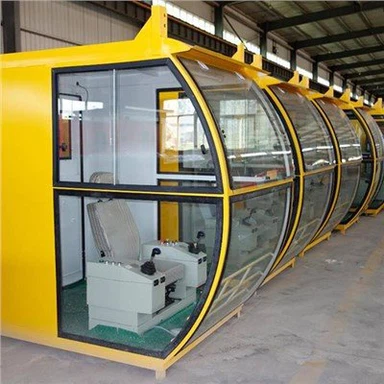
5.1 The operating room of gantry and bridge cranes should be padded with wooden boards or insulating boards. After the power is turned on, the metal structure should be tested with a test pen to confirm that there is no leakage before starting the machine. The upper and lower control rooms should use special escalators.
5.2 When the deflection of the main girder of the gantry and bridge crane exceeds the specified value, it must be repaired before it can be used.
5.3 Before operation
5.3.1 No-load operation should be carried out. After confirming that all mechanisms are operating normally, the brakes are reliable, and the limit switches are sensitive and effective, the operation can only be started.
5.3.2 Before starting, an electric bell signal should be issued to indicate that the lifting and lowering of heavy objects should be performed at a stable and uniform speed. When lifting large objects, fast speed should not be used, and the pull rope should be tied to prevent swinging.
5.4 Working
5.4.1 For gantry and bridge cranes operating in the open air, when encountering strong winds of level six and above, the operation should be stopped and the rail clamps should be locked.
5.4.2 It is strictly forbidden to pass above people and equipment in the lifting route of heavy objects. When walking with an empty vehicle, the hook should be more than 2m above the ground.
5.4.3 After lifting heavy objects, drive at a slow speed, and do not change speed or reverse suddenly during driving. When two cranes are operating at the same time, a distance of 3-5m should be maintained. It is strictly forbidden to use one crane to push another crane.
5.4.4 When the crane is moving, the two driving wheels should be synchronized. If deviation is found, the operation should be stopped, and it can be used after adjustment.
5.4.5 During operation, no one is allowed to cross from one bridge crane to another bridge crane.
5.4.6 When the operator enters the bridge frame from the control room or performs maintenance and overhaul, there should be an automatic power-off interlock device or cut off the power supply in advance.
5.4.7 When lifting flammable, explosive, harmful and other dangerous goods, it shall be approved by the competent safety department, and corresponding safety measures shall be taken.
5.5 After work
5.5.1 The gantry crane should be parked on the stop line, locked with the rail clamp, and the hook should be raised to the upper position; the bridge crane should park the trolley between the two rails.
5.5.2 Lift the hook to the upper position, and no heavy objects shall be hung on the hook.
5.5.3 Turn the controller to zero position, cut off the power supply, close and lock the doors and windows of the control room.

5.6 Electric hoist
5.6.1 Before using the electric hoist, check the mechanical and electrical parts of the equipment. The wire rope, hook, rope guide, limiter, etc. should be in good condition, the electrical part should have no leakage, and the grounding device should be in good condition.
5.6.2 Electric hoists should be provided with buffers, and baffles should be provided at both ends of the track.
5.6.3 When lifting a heavy object for the first time at the beginning of the operation, it should stop when it is 100mm above the ground, check the braking condition of the electric hoist, and start the formal operation after confirming that it is in good condition. The brake should be debugged by professional maintenance personnel. When working in the open air, a canopy should be provided.
5.6.4 It is strictly forbidden to lift the electric hoist with overload. When lifting, the hands must not be held between the rope and the object. When the hanging object is raised, it should be strictly prevented from colliding.
5.6.5 Lifting objects should be tied firmly. When the electric hoist lifts heavy objects and walks, the weight should not exceed 1.5m from the ground. Do not hang heavy objects in the air during work intervals.
5.6.6 In case of abnormal smell, high temperature and other abnormal conditions during the operation of the electric hoist, stop the machine immediately for inspection, and continue to use it after troubleshooting.
5.6.7 When using the suspension cable electrical control switch, the insulation should be good, the sliding should be free, there should be a 2m space behind the standing position of the person and the button should be operated correctly.
5.6.8 During hoisting, if a fault causes a heavy object to fall out of control, emergency measures must be taken to lower the heavy object to a place where no one is present.
5.6.9 It is strictly forbidden for one person to operate two or more electric hoists at the same time.
5.6.10 It is not allowed to go up and down rapidly during hoisting.
5.6.11 When the electric hoist brakes under the rated load, the sliding displacement should not exceed 80mm. Otherwise, remove the oil stain or replace the brake ring.
5.6.12 After the operation is completed, it should be parked at the designated location, the hook should be raised, the power supply should be cut off, and the switch box should be locked.
6 Exit of machinery and equipment
6.1 Prepare a special plan for crane disassembly.
6.2 The auxiliary equipment, tools, rigging and accessories required for crane dismantling must be in good condition, safe and reliable.
6.3 It is necessary to divide the work of the operating personnel and conduct safety technical disclosure, determine the command personnel, delineate the safety alert area and set up guardians, and eliminate operational obstacles.
7 information
7.1 Qualification certificates, business licenses, and safety production permits of equipment leasing units and lifting equipment installation units.
7.2 Machinery and Equipment Leasing Contract.
7.3 Mechanical equipment installation and dismantling contracts (lease unit has no installation and dismantling qualifications) and installation and dismantling safety management agreements.
7.4 Special construction plan for installation and dismantling.
7.5 The general contractor and the equipment leasing unit shall jointly disclose the safety technology of the operators and installation and dismantling personnel.
7.6 Registration form for special operators (attach copies of valid certificates).
7.7 Acceptance records of installation, dismantling, adding joints, etc.
7.8 Use license and inspection report.
7.9 Records of operation (use, repair, maintenance, failure, stagnation, accident), replacement of parts and shift change, etc.
7.10 Inspection records
7.11 Disclosure of safety technology for daily use.