

Lifting Crane Information For U
Apr 15, 2025
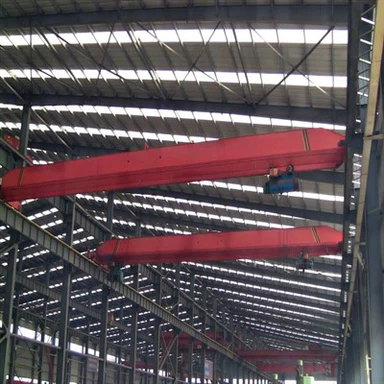
As the name suggests, a lifting crane is mainly used for lifting heavy objects in various fields. The bridge crane is our main product. The using guide and knowledge of the bridge crane are for your reference. Any questions, please feel free to contact us!
Precautions for the Use of Bridge Cranes
Bridge cranes are mechanical equipment that are installed above workshops, warehouses, and open storage areas to lift various objects. They are commonly known as "overhead cranes" or "traveling cranes". They are one of the most widely used types of lifting machinery in the mechanical, metallurgical, and chemical industries. In modern industrial enterprises, they are important equipment for achieving mechanization and automation of the production process, reducing heavy physical labor, and improving production efficiency. When using bridge cranes, the following safety precautions should be observed:
1. The crane must be in a normal state, especially the safety devices such as the braking mechanism, sound and light signals, interlock devices, etc., must be sensitive and in good condition.
2. During operation, the operator must be fully concentrated. Before lifting, perform an empty run first, then lift the load. When the lifted object is 100 to 150 mm off the ground, if it is found that the object is not securely bound, it should be re-bound. Before starting the crane, a signal bell should be sounded. The lifted object must not pass over people's heads. When the crane is in motion, it is strictly forbidden to repair, inspect, oil or wipe the machinery. If a fault is found during operation, the crane must be stopped immediately.
3. At the end of work, the crane should be parked on the parking line, the hook should be raised to the top, and no heavy objects should be hanging on the hook. All controllers and levers should be set to the zero position, and the power switch should be turned off and the cab door locked.
4. Bridge cranes must be equipped with reliable and sensitive safety devices. Generally, they are equipped with buffers, limiters (travel limiters, lifting limiters), lifting limiters, and anti-wind rail clamps, etc.
5. The outer casing of all electrified parts of the crane should be reliably grounded to prevent accidental electric shock to the operator. When the trolley track is not welded to the main beam, it should also be welded and grounded. The transformer should be grounded on the low-voltage side as required.
6. Bridge cranes must not lift under the following circumstances:
a. There is no one to command, or the command signal is incorrect.
b. The crane equipment has defects, or the safety devices are malfunctioning.
c. Lifting beyond the load capacity or the weight of the equipment is unknown.
d. People are standing on the lifted object or being lifted by the crane hook.
e. The light is dim and the view is unclear.
f. The lifted object has sharp edges or corners, or is lifted at an angle without taking safety measures.
Maintenance Requirements for Mechanical Equipment of Bridge Cranes
As an important part of the overall maintenance and care of bridge cranes, the maintenance of mechanical equipment is a crucial aspect. It mainly includes the following seven aspects:
1. Regularly inspect the brakes of the bridge crane and adjust the brake wheels on time to ensure the flexibility and reliability of the brakes and brake wheels. The gap should be maintained between 0.5 and 1.0 millimeters. It is necessary to ensure that there is no dirt on the friction surface. If any is found, it must be cleaned with thinner or gasoline.
2. Regarding the lubrication of the bridge crane, pay attention to the lubrication of the reducer, gearbox, and external meshing gears etc. At the same time, the hydraulic oil should be lubricated as required by the lubrication table.
3. Check the steel wire rope of the bridge crane following the relevant regulations. If it exceeds the regulations, it should be updated immediately.
4. Regularly check the cleanliness of the track and ensure that there is no dirt, sand, or gravel in the gears.
5. Pay attention to the tightness of the connection bolts of the bridge crane body when it is under pressure. Also, frequently check whether the connections between various components are firm. If any looseness is found, it should be tightened promptly.
6. Always pay attention to whether there is noise during the operation of the machine. If the operation is abnormal, it should be dealt with promptly.
7. Pay attention to the normal operation of the rotating mechanism. When checking, ensure that the center line of the bridge crane mechanism is parallel to the center line of the gear. Also, the gap in the middle should be appropriate.