

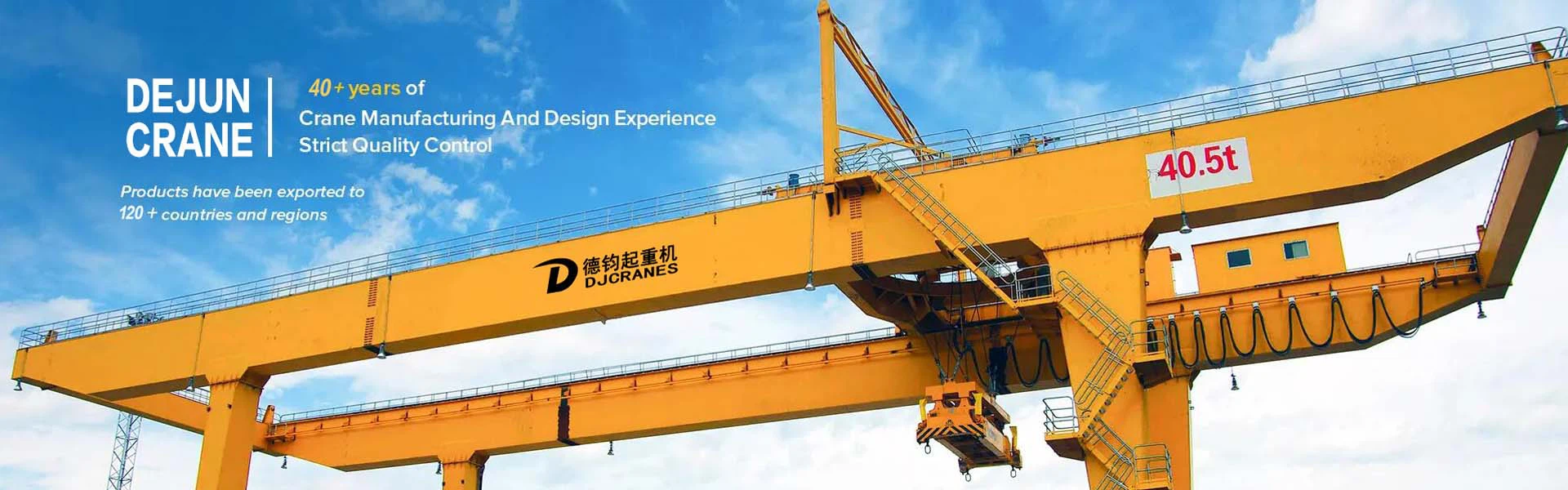


Bridge Crane / Gantry Crane Track
Bridge Crane/Gantry Crane Track Whether it is a bridge crane or a gantry crane, it is necessary to install the track before running. The quality of the crane track directly affects the running quality of the crane. The running tracks include crane rails, railway rails and square steel. The top...
- Fast Delievery
- Quality Assurance
- 24/7 Customer Service
Product Introduction
Bridge Crane/Gantry Crane Track
Whether it is a bridge crane or a gantry crane, it is necessary to install the track before running. The quality of the crane track directly affects the running quality of the crane.
The running tracks include crane rails, railway rails and square steel.
The top of the rail is convex, and the bottom is a flat plate with a certain width, which increases the contact surface with the foundation; the cross section of the rail is mostly I-shaped, with good bending strength.
Square steel can be regarded as a flat top rail. Due to the large wear on the wheels, it is generally only used for cranes with small lifting capacity, slow running speed and infrequent work.
Steel rails are usually rolled with carbon and high manganese steel (C=0.15%~0.18%, Mn=0.16%~115%).
A typical material for crane rails is U71Mn steel.
Square steel is mainly made of Q275 square steel or flat steel.
Crane rails are special cross-section rails used for crane carts and trolleys. The standard lengths are 9, 915, 10, 1015, 11, 1115, 12, 1215 and so on. Common specifications are QU70, QU80, QU100, QU120, and the number after QU indicates the width of the track head.
There are two types of railway rails: heavy rail and light rail, and the rail specification is expressed by the nominal weight per meter of length.
Rails with a weight greater than 30kg/m are heavy rails. The standard rail length has 12150m and 25100m2 specifications.
The weight of light rail is not more than 30kg/m rail, usually 5-12m in length. Most of the steel used for light rail is killed steel and semi-killed steel of ordinary carbon structural steel. In order to improve the wear resistance and corrosion resistance of the rail, low alloy structural steel with alloy elements such as Mn, Si and P have been used in recent years.

Installation Of Crane Rails
There are two commonly used track beams for installing tracks: one is a steel structure beam, and the other is a concrete prefabricated beam. Concrete prefabricated beams must have pre-embedded holes for bolts to be installed during installation, or
Embedded bolts in prefabricated beams. The installation methods of crane rails are fixed by pressing plate, hook screw, welding and bolt combination. In order to adjust the horizontal direction, the holes on the rail pressure plate are usually made as long holes, and the adjustment in the vertical direction can be added under the rail. When the rail pressure plate is designed, it must have sufficient rigidity. Each pressure plate can be made into a single hole or a double hole according to the magnitude of the force. Only when the track and the track beam or the fixed steel backing plate on the track beam are connected by welding, the gear can be welded on the track.
Installation requirements for track beams before track laying
1. Requirements for concrete track beams
(1) When manufacturing the track beam, it must be ensured that the position deviation of the reserved bolt holes along the horizontal and vertical sides of the beam is ≤5mm, the diameter of the bolt hole is 2-7mm larger than the diameter of the bolt, and the top surface of the beam is required to be flat, but not smooth.
(2) The installation deviation of the track beam must meet the following requirements, otherwise the track beam must be adjusted before leveling with concrete is allowed.
① The deviation of the beam center position from the design positioning axis is ≤5mm.
② The deviation of the beam top elevation from the design elevation is +10mm-5mm.
③ The reserved bolt holes on the beam and the displacement deviation of the reserved bolts to the center of the beam are ≤5mm.
(3) Construction requirements for concrete screed
① The strength grade of the concrete screed is C30, and the thickness is 30-50mm.
② Before the construction of the concrete leveling layer, the installation deviation of the track beam should be checked according to the requirements. If it does not meet the requirements, the track beam should be adjusted.
③ According to the measured elevation of the track beam surface, determine a suitable control elevation of the top surface of the concrete leveling layer, and set a reference point for the control elevation every 214-310m on the track beam.
④ Use instruments to measure, adjust the elevation of the reference point, and determine the reference line for the elevation of the top surface of the leveling layer, then install the formwork, remove the sundries on the top surface of the track beam and the bolt holes, and block the upper opening of the bolt holes.
Concrete can be poured after it is wetted with water.
⑤ The top surface of the leveling layer must be leveled and calendered, and there must be no exposed stones or unevenness. It is not allowed to level the surface by laying additional cement mortar.
⑥ Instruments should be used to measure and inspect at any time during construction. The top surface of the leveling layer must meet the following requirements: the non-levelness of the top surface within the width range of 400mm at the bolt is ≤5mm; The difference in elevation at the top of the bolts is ±5m.
⑦ Concrete is mechanically mixed, and maintenance should be strengthened during construction. When the concrete test block reaches 75% of the strength design value, the track installation work can be carried out.

2. Requirements for steel structure track beams
(1) The mid-span verticality of the track beam ≤ h/500, where h is the beam height of the track beam.
(2) The horizontal side bend of the track beam is ≤l/1500, and the net is 10mm, and l is the beam length of the track beam.
(3) The vertical arch of the track beam is ≤10mm.
(4) The deviation of the center position of the track beam from the design positioning axis is ≤5mm. If it does not meet the requirements, the track beam should be adjusted before the track can be installed.
(5) The height difference of the top surface of the track beam with the same cross section in the same span is ≤10mm at the support, and ≤15m at other places.
(6) The height difference of the top surface of the track beam between two adjacent columns in the same column is ≤l/1500, and ≯10mm, where l is the beam length of the track beam.
(7) At the joint of two adjacent track beams, the height difference between the top surfaces of the two track beams is ≤1mm, and the lateral displacement of the center is ≤3mm.
Hot Tags: bridge crane / gantry crane track, China bridge crane / gantry crane track suppliers, manufacturers, factory
