



Crane Control
The crane control is a device used for remotely controlling the operation of a crane or a hoist. It transmits instructions via wireless signals to enable the crane to perform operations such as lifting, lowering, and moving left and right.
- Fast Delievery
- Quality Assurance
- 24/7 Customer Service
Product Introduction
Ground operation for overhead cranes and gantry cranes primarily falls into two categories: wired pendant controls and wireless remote controls; our cranes are now equipped with both systems, serving as backups to one another.
Pendant cable control and wireless remote control introduction
Wired pendant controls:
Connects to the control cabinet via a cable; signals are transmitted through wires, eliminating the risk of signal interference. It is cost-effective but limited by cable length; commonly used for small single-girder bridge cranes and mobile gantry cranes.
Components: Pendant station housing, emergency stop (mushroom-head) button, directional buttons (Up/Down, Bridge/Long-travel Forward/Backward, Trolley/Cross-travel Left/Right), Start button, cable, cable sheath, suspension ring, and waterproof sealing gasket.
Control functions: Hoisting, bridge travel, and trolley travel; dual-speed models feature high- and low-speed settings.
Advantages: Strong resistance to electromagnetic interference, no battery-related issues, easy maintenance, and low cost.
-Disadvantages: Cables are prone to wear, snagging, and tripping hazards; operating range is limited by cable length; and cables age rapidly due to wind and sun exposure on outdoor gantry cranes.
Wireless Remote Control:
Consists of a transmitter (handheld unit) and a receiver (mounted in the crane's electrical cabinet). It uses radio-frequency signal transmission, allowing the operator to move freely and avoid hazardous areas; suitable for long-span gantry cranes, outdoor operations, and high-tonnage bridge cranes.
Transmitter components: housing, red mushroom-head emergency stop button, power key switch, start button, directional buttons, status indicator light, battery compartment, antenna, and shoulder strap attachment point.
Receiver components: receiver mainboard, relay output module, antenna, power fuse, and terminal blocks; the unit must be mounted on the exterior of the crane's electrical cabinet; enclosing it inside the cabinet is prohibited to avoid signal shielding.
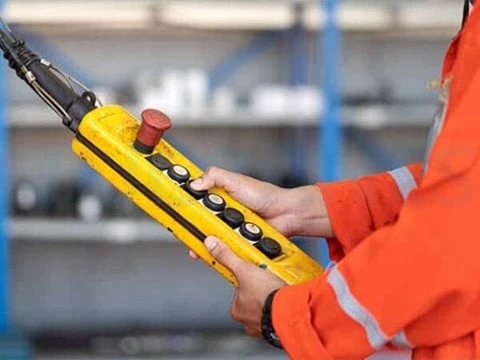
Crane Control Handle
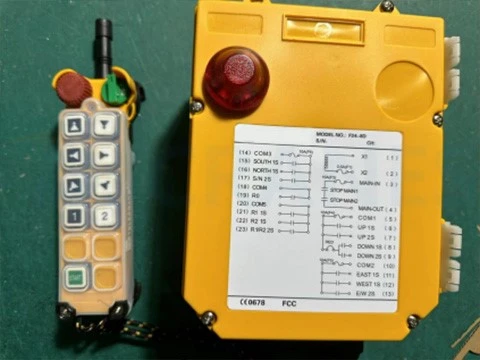
Wireless Remote Control
Pendant cable control and wireless remote control comparative analysis
|
Item
|
Pendant cable control
|
Wireless remote control
|
|
Connection Method
|
Physical connection to the crane control box via cable
|
Signal transmission via radio waves (e.g., 315 MHz, 433 MHz, 2.4 GHz)
|
|
Operational freedom
|
The operator must walk alongside the crane, limiting their range of movement
|
The operator can move freely within the effective range (typically a 100-meter radius) and choose a safe viewing angle
|
|
Safety Risks
|
Risk to the operator's personal safety in hazardous environments (e.g., where suspended loads are passing overhead)
|
Operators can stay clear of the danger zone, ensuring greater safety
|
|
Applicable Scenarios
|
Single-girder bridge cranes and gantry cranes; small-scale or simple applications
|
Various types of cranes; particularly suitable for complex, large-scale, and harsh operating conditions
|
|
Typical Configuration
|
A tethered handheld controller connected to a control box, typically featuring a limited number of buttons
|
Consists of a transmitter (handheld unit) and a receiver (mounted on the equipment).
|
Standard Operating Procedure (Applicable to Bridge Cranes and Gantry Cranes):
To ensure safety, operations must follow these guidelines: Perform pre-operation checks. Inspect the remote controller or handheld unit to confirm that buttons operate smoothly and signal transmission is stable; for wireless controllers, verify that the battery level is sufficient. Check the equipment status: before powering on, ensure all controller handles are in the neutral position.
Wired Pendant Cable Control Operating Procedures
1. Switch on the main power supply.
2. Inspect the pendant housing and cable for any damage.
3. Reset the emergency stop and test movements in all directions.
4. Upon completion of work, hang the pendant back in its designated place; do not drag the cable.
Wireless Remote Control Operating Procedures:
1. Switch on the crane's main power supply.
2. Insert fully charged batteries into the transmitter, insert the key into the switch, and turn on the power.
3. Press the Start button; the indicator light should flash green normally.
4. Test-operate each function to verify that the limit switch and emergency stop functions are working correctly.
5. During operation: If the signal degrades or the indicator light flashes red (indicating low battery), stop operations immediately.
6. After operation: Press the emergency stop button, remove the key, take out the batteries, and store the remote control properly.
7. Emergencies: Immediately press the red mushroom-shaped emergency stop button to halt all mechanical movements; shut off the crane's main power supply if necessary.

Wireless Remote Control For Electric Hoist

Wire Pendant Controls For Crane
Crane Controls Repair Precautions
1. Remote Control: Repairing the main circuit board yourself is not recommended; for most malfunctions, replace the entire transmitter/receiver assembly to ensure the reliability of the safety circuit.
2. Pairing (code matching) is required when replacing the remote control.
3. Comprehensive testing must be performed after repairs are completed, including checks for all mechanism movements, emergency stop function, limit switch operation, and automatic shutdown upon signal loss.
4. Bypassing or short-circuiting safety devices-such as emergency stops or key switches-is strictly prohibited; doing so constitutes a violation of regulations regarding special equipment.
Crane Controls Maintenance Tips
Daily Inspection
Inspect the housing, emergency stop button, battery/cables, and indicator lights; test the emergency stop function.
Weekly Maintenance
Wireless Remote Control: Clean dust and oil/grease from the housing and antenna; inspect battery compartment contact springs.
Wired Pendant: Check cables for wear and ensure the suspension ring is securely attached.
Monthly Maintenance
Test remote control signal range; inspect receiver terminals; check relay contacts for signs of arcing or burning.
It is recommended to replace remote control batteries periodically rather than waiting until they are completely drained.
Annual Inspection
Verify the remote control's safety functions for the entire unit; inspect the receiver antenna; test the signal-loss shutdown function.
Calibrate the zero position for joystick-style remote controls; verify the integrity of all safety circuits.
Criteria for Scrapping
Severe housing cracks, emergency stop failure, burnt-out mainboard, or severe internal wiring corrosion. Replace the entire pendant/remote control unit; do not continue use.
Finally Words
Dejun has more than 30 years in the crane field and specializes in customized service. We have enough confidence to provide top-quality cranes and suitable solutions. If you have any questions, contact us freely; our team is always here.
Hot Tags: Crane Control
