

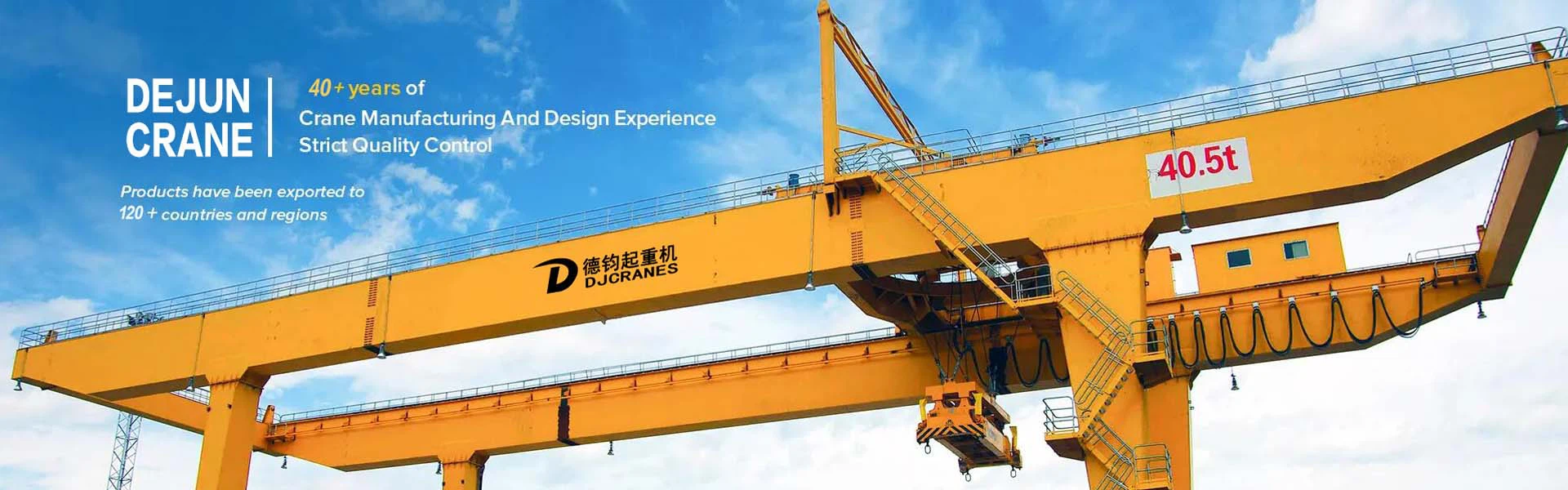

Small Overhead Crane
Dejun brand small overhead crane is composed of the main girder, end girder, electric wire rope hoist and operating mechanism welded by steel plate and I-beam.We offer customized solutions and modify our products to meet specific customer needs. Our team of experienced engineers works closely with clients to understand their requirements, and we provide expert guidance to help them make the right decision.
- Fast Delievery
- Quality Assurance
- 24/7 Customer Service
Product Introduction
1. Product Introduction:
Dejun brand single girder small overhead crane is composed of the main girder, end girder, electric wire rope hoist and operating mechanism welded by steel plate and I-beam.We offer customized solutions and modify our products to meet specific customer needs. Our team of experienced engineers works closely with clients to understand their requirements, and we provide expert guidance to help them make the right decision.
This type of small overhead crane is specially created to cater to a broad range of material-handling needs, and it is widely used in various industries, including construction, manufacturing, and mining.

2. Parameters:
|
Lifting Weight(t) |
1 |
2 |
3 |
5 |
10 |
16 |
Customized |
|||||||||||||||||||||
|
Span(m) |
7.5 |
10 |
15 |
18 |
8 |
13 |
18 |
27 |
7.5 |
12 |
18 |
23 |
8 |
12 |
15 |
18 |
8 |
12 |
15 |
20 |
12 |
19 |
25 |
28 |
Customized |
|||
|
Working Speed |
Ground 20 |
Ground 20 |
Ground20
|
Ground 20 |
Customized |
|||||||||||||||||||||||
|
Hoisting Height(m) |
Customized |
|||||||||||||||||||||||||||
|
Working Class |
A4 or Customized |
|||||||||||||||||||||||||||
|
Electric Current |
Customized |
|||||||||||||||||||||||||||
3. Component:
It is mainly composed of a box-shaped bridge, a lifting trolley, a trolley operating mechanism and an electrical control system. The retrieval device is a hook. Tracks are laid on the main beam for the lifting trolley to move laterally along the direction of the main beam.
The main beam and the box-shaped end beam are welded, and there are joints, bolts or pins in the middle of the end beam for the bridge to be dismantled and transported. There are three operation modes: ground handle, wireless remote control and driver's cab.
There are two types of cabs: open and closed. There are adjustable seats inside, the floor is laid with insulating pads, and the windows are made of tempered glass. It can be equipped with heating and cooling air conditioners, buzzers, intercoms and other items according to user requirements.
The crane can be equipped with hanging motor grabs, electromagnetic suction cups and other retrieval devices to meet the needs of lifting various types of materials. The working level of the crane is A3~A7, and the common lifting capacity is 3~250t. It is suitable for loading, unloading and lifting in factories, warehouses and freight yards where the ambient temperature is -20℃~40℃ and the relative humidity is no more than 85%. It is prohibited to work in flammable, explosive and corrosive gas environments.
4. Routine inspection of bridge crane maintenance
(1) Always check whether the hook, wire rope, brakes, limiters and safety switches of each mechanism are sensitive and reliable. Check whether there are cracks, wear and torsional deformation in the hook; whether there are broken wires in the wire rope; whether the gaps between the brake belt friction plates on both sides of the brake wheel and the brake wheel of each brake are equal; the actual contact area should not be less than the theoretical 70% of the contact area.
(2) Check the mechanism transmission parts and the fastening status of each electrical component one by one. Tighten the pulley shaft nut and stopper, and check the wear of the balance wheel. All parts of the crane must be regularly lubricated and maintained to ensure that each component is in good operating condition and extend the service life of the crane and parts.
(3) Maintain a good sanitary environment. During operation, if the operation is unstable or there is abnormal noise in each transmission part, the cause must be identified and eliminated.
(4) Check whether the lubricating oil of the reduction box is added to the specified oil level, whether the screws are tightened, and the gap between the connecting shafts of each coupling should be 4~5mm.
(5) Check the controller and protection cabinet resistors, and replace the severely worn moving and static contacts. The handwheel should be flexible and reliable, and should not be stuck or too loose.
Among them, we should also pay close attention to the wear and tear of the wire rope, which is directly related to the safety of the crane hoisting. In the past few years of work, I have summarized the most feasible and economical method for maintaining wire ropes.
The most critical thing in the maintenance of wire ropes is lubrication, but simply applying grease to the surface of the wire rope cannot fundamentally solve the problem, because the grease cannot penetrate into the inside at all, and not every section of the wire rope can be touched. In response to this situation, I thought of using the heating method, which is to use the waste oil that we usually replace, heat it to a certain temperature, and pour it on the steel wire rope, and at the same time perform the lifting and lowering operations, so that each section of the steel wire rope can be lubricated. Due to the lubrication After the oil is heated, it can penetrate into the core of the steel wire rope, so that the steel wire rope is not only smooth and shiny, but also saves costs.
5. Troubleshooting for bridge crane maintenance
In the daily operation of the crane, we sometimes encounter some minor faults and troubles, which requires the driver to handle them by himself and eliminate the faults.
(1) If the brake fails, the car cannot be stopped, and the sliding distance of the large or small car is too long after power is cut off, it may be due to oil stains on the brake surface, serious wear of the brake shoe lining, improper adjustment of the main spring, or fatigue aging. . In response to this situation, corresponding measures should be taken to clean the brake working surface with kerosene, replace the aging tile lining, and adjust the tension of the main spring.
(2) If the brake cannot be opened, the motor makes abnormal noise, and the tile lining emits a burnt smell or smokes, then the main spring may be too tight, the tile lining glue is stuck to the brake wheel, or the movable hinge is stuck, and it must be cleaned. Lining the working surface of the brake wheel; clearing debris in the stuck area, lubricating the hinges; adjusting the main spring to make it meet the standard requirements.
(3) Although there are some failures that are not very common, if they occur, they cannot be solved by ourselves as a crane driver. Of course, they do not appear suddenly, but develop slowly over the life of the crane. For example: serious wear of the gears of the reduction box causes excessive tooth side clearance, causing vibration of the mechanism; rail bites appear on the trolley; fatigue cracks occur in the metal mechanism, main beam deformation, deflection, etc. Due to the friction between the parts that make up the crane, it causes wear and tear of the parts, as well as corrosion and aging factors. When the damage reaches a certain level, it should be scrapped immediately if it cannot be repaired or has no repair value. The scrap standard can be scrapped according to GB6067---86 "Safety Regulations for Hoisting Machinery", combined with the information provided by some relevant materials.
Hot Tags: small overhead crane, China small overhead crane suppliers, manufacturers, factory
