


Hoist Bridge
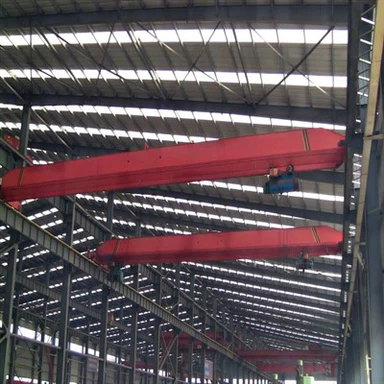
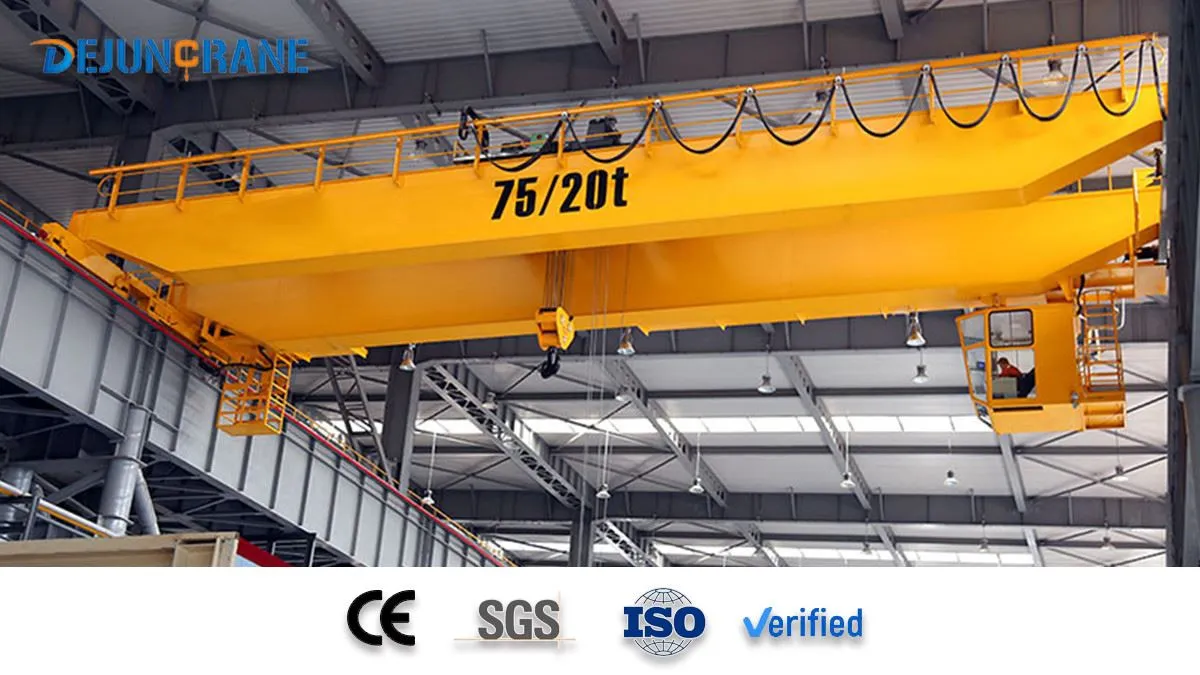
EOT double hook hoist bridge is composed with Girder frame, Crane travel device, and the trolley with lifting and moving device. There are Pave the rail for the trolley move on the main girder.
- Fast Delievery
- Quality Assurance
- 24/7 Customer Service
Product Introduction
1. Product Introduction:
EOT double hook hoist bridge is composed with Girder frame, Crane travel device, and the trolley with lifting and moving device. There are Pave the rail for the trolley move on the main girder.
Assemble the moving table on the outside of the two main girder, one side is prepare for the assemble and maintenance the crane move device, another side is prepare for the assemble of the trolley conductor device.
There are full field of view Cabin suspend under the main girder, there are joint control desk or single control box packed within the Cabin, assemble the sidelong ladder between the Cabin and moving table, The main girder joint with the two side end carriage which with the joint point in the middle.
In general, the main hook has a large lifting tonnage, a slow lifting speed and low efficiency; the auxiliary hook has small lifting tonnage, fast lifting speed and high efficiency; the two hooks of the EOT double hook hoist bridgeare generally operated independently. In special cases, the main and auxiliary hooks can also be used together to complete the operation process. The working Class is different according to the working conditions: A5-A8.
2. Component:
The hoisting action of the crane, the operation of the trolley and the operation of the trolley work together to form a three-dimensional space, so that the material can be hoisted to any position in the hoisting workspace.
Large-tonnage overhead cranes generally have two sets of hoisting systems, which are mainly composed of box bridges, hoisting trolleys, cart operating mechanisms and electrical control systems. The retrieval device is the two hooks on the lifting trolley.
The trolley runs left and right on the girder, which is mainly used to move the lifted weight to a more precise position. The operation of the trolley is the same as that of the cart, but the directions that can be run are different. The running directions of the trolley and the cart are just perpendicular to each other.
The main hook is the main hook, which has the following characteristics: large lifting capacity and slow lifting speed. Most of the work of the crane is done by the main hook, especially when lifting heavy materials. After the rated lifting capacity of the auxiliary hook is exceeded, it can only be lifted by the main hook for safety reasons.
3. Applicable Environment:
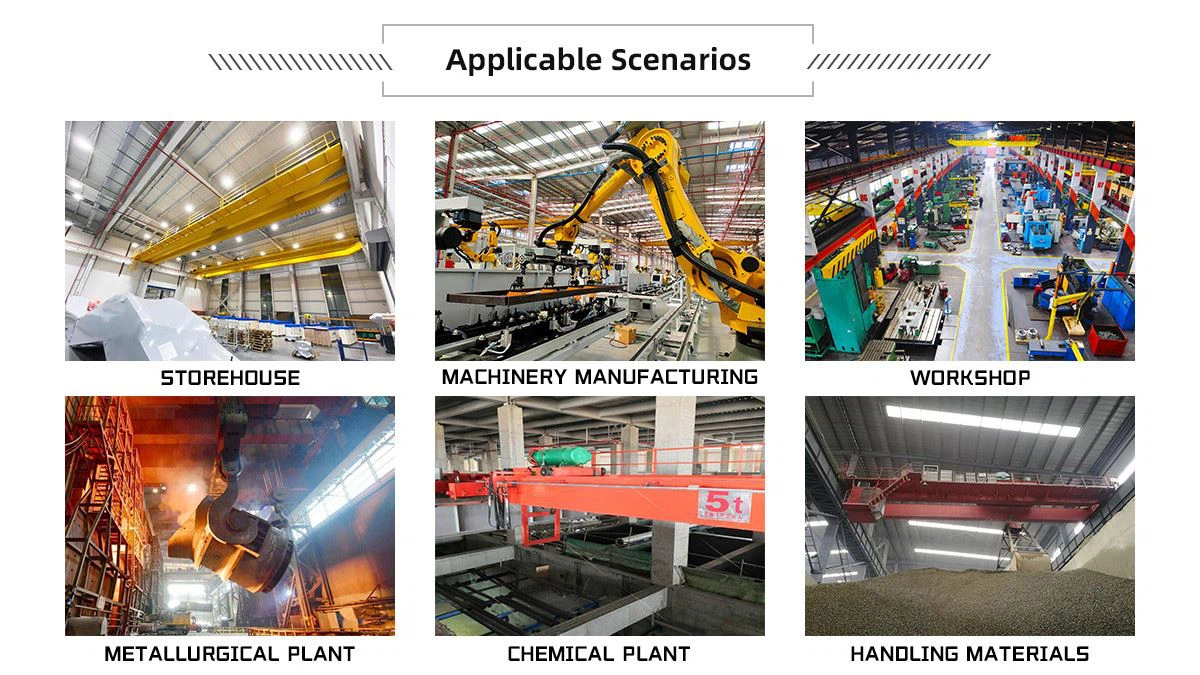
The EOT double hook hoist bridge is suitable for lifting work in machining, assembly workshops, metal structure workshops, metallurgy and foundry workshops and various warehouses;
4. The electrical safety devices on bridge cranes mainly include:
(l) Lighting switch box: used to ensure the lighting of the work site and the power supply of the electric bell.
(2) Stroke limit switch: used to limit the operation of machinery driven by the motor within a certain range to prevent accidents caused by overside of the machinery driven by the motor.
(3) Emergency switch: It is installed next to the driver's cab to allow the driver to cut off the power supply of the control circuit conveniently and quickly in case of an accident or emergency.
(4) Door cabin safety switch: It is installed at the door and hatch to prevent accidents caused by the driver blindly sending power when someone is getting on and off the crane or working on the crane platform.
(5) Fuse: used to protect the control circuit from short circuit.
(6) Overcurrent relay: protects the main circuit and motor from overload and short circuit.
(7) The zero position contact of the controller: protects the zero position start and prevents the controller handle from being able to send power to start when the controller handle is in the working position. An accident may occur if the motor is allowed to run on its own.
The mechanical safety devices on bridge cranes mainly include:
(1) Railings: In order to protect the safety of workers and prevent accidents caused by accidental falls. Railings of no less than 1m are installed on the outside of the platform, end beams and trolleys.
(2) Baffles: The endpoint baffles on both sides of the trolley and the trolley are to prevent the trolley and trolley from being offside and causing accidents; the trolley sliding contact line baffle is to prevent the hook from swinging offside and causing an electric shock accident.
(3) Buffer: It works jointly with the end baffle (impact block) to reduce the impact when the car collides with the car, or the car and the end point impact block of the track (buffers for cranes are mostly spring-type).
(4) Guards: Rapid transmission shaft guards, hook guards, pulley block guards, etc. are used to protect the safety of moving parts, ensure the safety of personnel, and prevent collision damage to cast iron parts.
5. Transportation:
Shipping way: by sea, air, land, and Express such as DHL, TNT, UPS, FEDEX. We will choose the suitable shipping method according to your requirements.

6. The acceptance criteria for traveling beams of bridge cranes are mainly as follows:
1) The coordination between the entire crane and the factory building, as well as the coordination between the trolley and the bridge frame, must be appropriate. The mutual cooperation between the trolley and the bridge mainly lies in: the trolley gauge (the horizontal distance between the wheel center planes) and the trolley gauge on the bridge should be the same; secondly, the position of the buffer on the trolley and the stopper on the bridge should match well. , the striker on the trolley and the travel limit switch on the bridge must match properly. The layout of the trolley should be compact and the height should be small. Correspondingly, the height of the crane can be reduced, thereby reducing the height of the factory building.
2) The layout of the mechanism on the trolley and the coordination requirements between various parts in the same mechanism are appropriate. The distance between the lifting mechanism and the trolley operating mechanism should not be too small, otherwise maintenance will be inconvenient or the trolley frame will be difficult to design; but it should not be too large, otherwise the trolley will not be compact.
3) The wheel pressure distribution of the trolley wheels must be uniform. And it is required to obtain the minimum size of wheels, axles and bearing boxes, and to ensure uniform load on the main beam of the crane bridge. Generally, the maximum wheel pressure should not exceed 20% of the average wheel pressure.
4) The mechanism on the trolley frame must match properly with the trolley frame. In principle, the design should focus on the mechanism, and try to use a trolley to match the mechanism; at the same time, the layout of the mechanism should also be as convenient as possible to design and manufacture the steel structure. Because the trolley frame is to house and support the lifting mechanism and the trolley operating mechanism, the trolley frame should be designed according to the requirements of the lifting and operating mechanism. However, without affecting the work of the mechanism, the layout of the mechanism should also match the requirements of the trolley. The design of the frame makes its structure simple, reasonable and easy to manufacture.
Note: In addition to meeting the above conditions, it must also meet the standards of the local Quality and Technical Supervision Bureau to be considered qualified.
Hot Tags: hoist bridge, China hoist bridge suppliers, manufacturers, factory