

How To Prevent Crane Collisions?
May 28, 2023
How to prevent Crane Collisions?
When the running mechanical position limiter or braking device fails, due to inertia, the crane or trolley running to the end will collide with the set stopper at the end of the run.
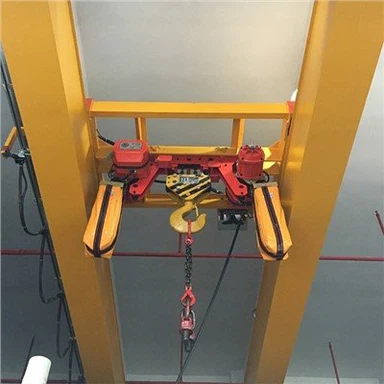
In order to prevent the collision of lifting equipment during operation, Dejun Crane recommends that customers purchase a crane with anti-collision devices and buffers.
The anti-collision device is an anti-collision system for cranes, quay cranes, rail cranes, portal cranes and other lifting equipment running on the track. The anti-collision instrument is used to prevent the collision of lifting equipment during operation and provide guarantee for safe operation.
According to the type of sensor used, the anti-collision device can be divided into infrared sensor and laser sensor.
Infrared sensor, the maximum detection distance is 20 meters. There are two sets of sensors on the left and right, which can detect the left and right directions. Voice alarm with adjustable volume.
Technical Parameters
|
Operating Voltage |
AC110V/AC200-240V (special voltage can be customized) |
power frequency |
50Hz~60Hz |
|
Alarm volume |
80 decibels |
Response time |
0.5s |
|
Detection distance |
Level I: 5-20m adjustable |
Power |
AE401A:≤10W |
|
Level II: 3-12m adjustable |
AE401C:≤20W |
||
|
Output contact load (resistive) |
AE401A: 0.5A 125VAC/ 1A 30VDC |
||
|
AE401C: 12A 125VAC/ 7A 250VAC/ 7A 30VDC |
|||
|
Operating temperature |
-30°C ~ +70°C |
degree of protection |
AE401A: IP65 |
|
AE401C: Indoor type |
|||
|
Working humidity |
10% ~ 95% (non-condensing) |
installation method |
screw fixed installation |

Buffer
The purpose of setting the buffer is to absorb the running function of the crane or trolley to reduce the impact. The buffer is arranged at the position where the 15 ton bridge crane or the lifting trolley prevents the bumpers from colliding with each other.
Buffers should also be set between cranes running on the same track and between double trolleys on the same bridge.
Physical Buffer
1. Rubber buffer: This kind of buffer has a simple structure, but it can absorb less energy. It is generally used in occasions where the running speed of the crane does not exceed 50/min, and it mainly plays a blocking role.
2. Polyurethane buffer: Polyurethane foam plastic buffer has large energy absorption, good buffer performance, oil resistance, aging resistance, acid resistance, corrosion resistance, high temperature and low temperature resistance, insulation and explosion-proof, relative density is small and light, simple mechanism, low price, no Noise, no spark, easy installation and maintenance, long service life and so on. Therefore, it has been widely used in the world. On general cranes, it can replace rubber and spring buffers, and it is more worthy of promotion in explosion-proof places.
Spring Buffer
The spring buffer is mainly composed of a bumper, a spring and a housing.
It is characterized by relatively simple mechanism and reliable use. When the crane hits the spring buffer, its energy is mainly transformed into the compression energy of the spring. Improved spring buffer with anti-bounce mechanism to prevent kickback forces.
Hydraulic Buffer
When the buffer is subjected to collision pressure, the kinetic energy is transferred to the piston through the plug head and the acceleration spring to make it move to the right. Originally, a return spring, ejector rod and oil are housed in the working chamber of the buffer.
The movement of the piston squeezes the oil in the working chamber to compress the return spring, and at the same time, the oil is squeezed out from the annular gap between the piston and the ejector rod and enters the oil storage chamber.
When the piston starts to move, due to the large annular gap between the piston and the ejector rod, the oil is easily squeezed out; when the piston continues to move, this annular gap becomes smaller and smaller, that is, the piston resistance continues to increase. After reaching the cylindrical stage of the ejector pin, the annular gap is almost invisible, and the resistance is also stable at the maximum value. The process of the buffer being compressed is the process of squeezing the oil through the piston to do work. This process consumes a lot of kinetic energy and acts as a buffer. When the work is finished, the piston is pushed to the original position by the return spring to complete a working cycle.