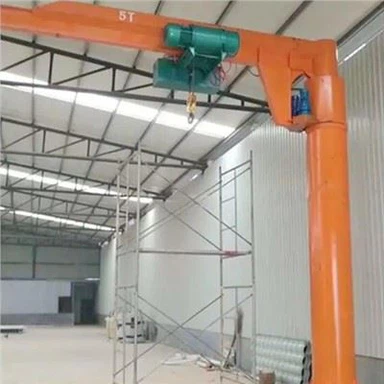


FAQ For 5 Ton Gantry Crane
Apr 28, 2023
FAQ for 5 ton Gantry Crane
The common problem of 5 ton gantry crane is the three major components, which refer to the hook, wire rope and brake respectively. Once there is a problem with these three components, it is very easy to cause the hanging object to fall, and even cause serious casualties.
The common problem of the hook is mainly the decoupling of the heavy rope, that is, when the object is not well bound, the angle between the heavy rope exceeds 120 degrees, or the hook is touched sideways during lifting, and the heavy rope will fall from the hook when the bottom of the heavy object is placed. out.
In addition, because the hook is made of gray cast iron or cast steel, it is brittle, not resistant to impact, and easy to break. Therefore, if the site is narrow or the operator is careless during the lifting process, the pulley will be damaged due to collision. and damaged.
Once the pulley is damaged, its rim breach will cause the cutting of the wire rope, or even cut off the wire rope and cause an accident. If the operator fails to refuel the hook pulley in time, the wear of the bottom of the groove may exceed the standard due to inflexible rotation of the pulley. Over time, the pulley will be half-cracked, and the hook will cause an accident during operation.
Not only that, when the amount of wear at the bottom of the groove increases, the embedded amount of the steel wire rope will be deep and the friction resistance will increase, which will lead to a deeper embedded amount of the steel wire rope and increase the resistance, which will cause the steel wire to fluff and accelerate scrapping.

Wire Rope
The common problems of wire rope are generally caused by human factors.
For example, when the operator is operating, the steel wire rope often rubs and scrapes against some equipment and buildings, resulting in partial wire breakage and deformation of the outer layer of the steel wire rope;
When the reel is operated, the wire rope is wound in multiple layers on the reel in confusion;
The hook rotates frequently in the air, and the wire rope is kinked;
Long-term lack of oil on the steel wire rope makes the surface rust;
The steel wire rope is often burned at high temperature and the steel wire rope is burned when it touches the high-voltage power line, which is also the cause of the accident.

Brake
Common problems with brakes are:
The main spring of the brake is damaged or the adjustment is too loose, and the braking torque is insufficient; the excessive wear of the brake shoe exposes the cap nails, resulting in insufficient friction, and the brake cannot brake heavy objects;
The lock nut of the brake lever is loose, the lever moves, or the joints of the lever system are stuck, etc., which affect the brake; the opening clearance of the brake shoe is abnormal. On the other side, the added tiles are also attached to the brake wheels, which accelerates the wear of the brake shoes and the brake wheels, and the car cannot be braked when it is heavily loaded.
In addition, too tight brakes are also unfavorable, because when the brake opening gap is smaller than the normal value, the resistance of the brake wheel rotation will increase, and you will often smell burnt skin. have an accident.

To ensure the safe use of the three major components of the crane and prevent accidents, this requires each crane user and operator to do the following:
1. To ensure that the anti-decoupling device of the hook is intact, the hook should be anti-collision when in use; it is necessary to refuel each lubrication point frequently; if cracks, breaks or wear exceed the standard, the pulley should be replaced in time.
Check the hook body frequently, and rectify it in time when cracks and wear of the hook mouth exceed 10% of the thickness and the opening degree changes. It is worth noting that the defects of the hook cannot be repaired and welded.
2. When the wire rope is in use, sharp angles should be avoided.
The starting (braking) and acceleration (deceleration) speed of the 5 ton gantry crane must be slow to prevent the wire rope from being broken due to excessive force.
When the crane is working next to the power line, pay attention to ensure a sufficient safety distance from the power line to prevent the wire rope from hitting the power line and being burned.
When the wire rope is in contact with the sharp corners of buildings and equipment, it should be padded with wooden blocks.
The wire ropes should be neatly arranged on the reel without confusion to avoid damage under pressure.
Do not weld on the side of the wire rope to prevent high temperature arc and welding slag from burning the wire rope.
When the wire rope is too short, it is not allowed to take a long way to re-use.
To strengthen the maintenance of the wire rope, often use kerosene and other cleaning agents to wash off the dirt on the wire rope, and pay attention to dipping the lubricating oil into the wire rope.
During operation, the operator should check the wire rope once a day, pay attention to check whether the wire rope is worn, broken wire, corrosion, diameter change and other physical and chemical changes, and pay attention to check the fixing condition of the rope end.
3. When working on a 5 ton goliath crane, the operator should carefully check whether the parts of the brake are operating normally, whether they are jammed, whether the clearance of the brake shoe is appropriate, whether the surface of the brake ring is good, and whether the adjusting nut is tight.
The lubrication of the brake should be carried out twice a week, but be careful not to get the lubricating oil on the friction parts.
If the wear of brake shoes, brake wheels, small shafts, mandrels, etc. exceeds the standard; the main spring and auxiliary spring are broken or plastically deformed; cracks appear in the brakes, etc.; , Due to timely repairs, it is not allowed to run sick to ensure safety.