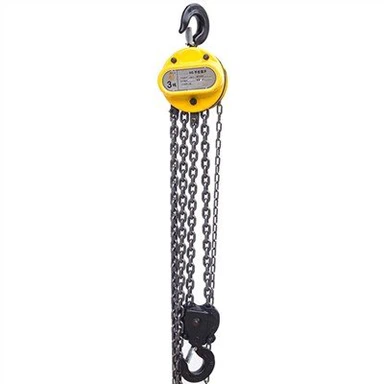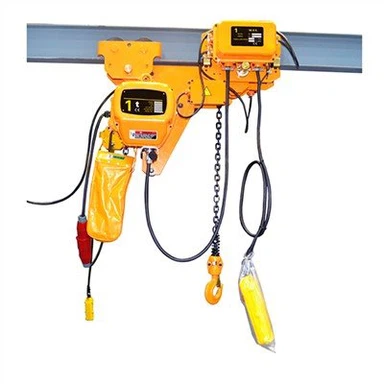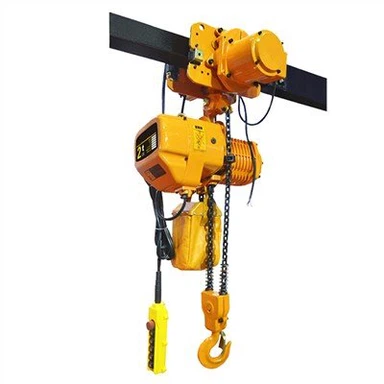

1/4 Ton 10 Ton 25 Ton Fixed Type Electric Chain Hoist
Hoist, mechanical device used primarily for raising and lowering heavy loads but occasionally for moving objects horizontally. It usually consists of a block and tackle—a combination of one or more fixed pulleys, a moving pulley with a hook or other similar means of attaching loads, and a rope (or cable) between them. Motive power for a hoist may be either manual or supplied by an electric motor. Electrically powered hoists, commonly mounted to the floor or wall, are used for varied lifting and hauling operations in factories and warehouses.
- Fast Delievery
- Quality Assurance
- 24/7 Customer Service
Product Introduction
What Is Hoist
Hoist, mechanical device used primarily for raising and lowering heavy loads but occasionally for moving objects horizontally. It usually consists of a block and tackle-a combination of one or more fixed pulleys, a moving pulley with a hook or other similar means of attaching loads, and a rope (or cable) between them. Motive power for a hoist may be either manual or supplied by an electric motor. Electrically powered hoists, commonly mounted to the floor or wall, are used for varied lifting and hauling operations in factories and warehouses.
Advantages of Hoist
Productivity in moving heavy loads
This lifting system boosts throughput in transporting heavy loads compared to conventional handling equipment. The hoist operates within a limited space, avoiding unnecessary travel.
Safety in internal material transport
The hoist enhances safety in the facility by eliminating direct interaction between operators and the lifting of loads. Additionally, the hook incorporates a safety latch to prevent products from falling.
Ease of use
Operators activate the lifting system through a remote control, without the need for direct involvement in the operation.
Adaptability to all facilities
Hoists have multiple configurations based on variables such as the type of load to be lifted or the location where they need to be installed. Nevertheless, using a hoist does have certain limitations.
Why Choose Us
Professional team
Our professional team collaborates and communicates effectively with each other, and is dedicated to delivering high quality results. We are capable of handling complex challenges and projects that require our specialized expertise and experience.
Advanced equipment
A machine, tool or instrument designed with advanced technology and functionality to perform highly specific tasks with greater precision, efficiency and reliability.
High quality
Our products are manufactured or executed to a very high standard, using the finest materials and manufacturing processes.
Quality control
We have built a professional quality control team to accurately inspect every raw material and every production process.
Customized services
We understand that each customer has unique manufacturing needs. That's why we offer customization options to cater to your specific requirements.
24H online service
We try and respond to all concerns within 24 hours and our teams are always at your disposal in case of any emergencies.
Hoist Applications in the Warehouse
A hoist is a mechanical device used to lift and move heavy loads vertically.It consists of a combination of pulleys, cables or chains, and a lifting system that allows applying a multiplied force to lift heavy objects with less human effort.Hoists are used in a wide range of industries, such as construction, manufacturing, and logistics, where it is required to lift and transport loads efficiently and safely. In addition, hoists are often portable and can be manually, electrically or hydraulically powered to suit different needs and work environments.nA hoist has several key features that make it a versatile and efficient device for lifting loads.There are different types of hoists that adapt to different needs and applications. The manual hoist is powered by human power and is ideal for light loads or occasional jobs. Electric hoists use electric motors to lift heavier loads more efficiently and are controlled by switches or remote controls. Air hoists use compressed air for lifting and are ideal for explosive environments or with high load requirements. Chain hoists, which use chains to lift objects, and wire rope hoists, which use steel cables for lifting. A hoist can be employed in all types of logistics centres, production lines and assembly facilities that handle bulky and heavy loads. Hence, these lifting solutions are often used in the automotive or construction industries, among others. Businesses resort to this kind of hoist system to load very heavy goods that can' t be safely handled by operators or forklifts. In these cases, the hoist is integrated into the overhead crane to lift the loads and move them to their destination in the facility. There are multiple hoist configurations depending on the type of products to be handled, the load-bearing structure where the hoist is installed or even the particular needs of each customer. The maximum capacity of the hoist is determined by the manufacturer according to, for example, the number of pulleys or the presence of a lift motor on the machine. The different types of hoists are operated similarly: the operator uses a controller to engage the hoist. The system activates a motor that enables the lowering of the hook from the machine to pick up and lift the load.
At first, it can be difficult to know what the most suitable hoist is for an individual, with a number of different considerations to take into account. The key things to look out for revolve around the ability of the individual to be hoisted, the weight of the individual being hoisted and the environment in which the hoisting is to take place. Once you have those details, it is important to work with an approved hoist supplier and listen to advice from care professionals to help you choose the right hoist specification. They can advise you on the type of hoist system you need for your care requirements and space, as well options such as slings and spreader bars. To help streamline this process, read How do I choose the right ceiling track hoist system? As the most common type of hoist system, ceiling hoists and overhead hoists are designed to provide a safe, quick way to transfer and move people around from room to room. Unlike a mobile hoist, they reduce trip hazards and keep rooms looking tidy. They also have a greater lifting range, which means they are ideal for longer range transfers where patients need to move between rooms, or alternate higher and lower positions.For care environments such as care homes and hospices, the most common type of layout for hoist tracking is an H-frame system, sometimes called an X-Y system. This consists of three pieces rather than one single rail, involving two parallel fixed rails and one perpendicular moving traverse rail. By opting for this system, individuals and carers can carry out transfers between multiple locations, such as a bed to a chair or a bed to a wheelchair.
Integrated into an overhead crane, a hoist is a helpful solution in a logistics facility or production centre for raising and moving materials within defined areas. The main advantage of this lifting system is its adaptability, as it offers a wide range of configurations to accommodate various load types. Finding the right lifting solution for your workspace can be confusing. Our guide will help you learn and understand the differences between a crane and a hoist so you can make the best decision for your specific site requirements. Cranes and hoists are used across all construction, manufacturing, and production industries. They can increase both site safety and the capabilities for maneuvering large and heavy objects. The words crane and hoist are sometimes used interchangeably but they are fundamentally different. A hoist is the crucial component of a crane, without which a crane cannot actually lift anything. That is because the hoist provides the vertical motion required to raise and lower the load, while a crane adds multiple directions of motion with the use of runways and booms/bridges. Hoists lift objects vertically (up and down) while cranes are capable of maneuvering vertically and horizontally (forward and back). However, cranes and hoists are often two parts of the same system. One of the most common misunderstandings, when people are learning about hoists and cranes, is the difference between the two. Hoists and cranes often work together to achieve the same goal: to lift or lower something. Typically, a hoist provided 1-Dimensional movement as it goes up and down. However, when a hoist is mounted on a crane, it allows for 2-Dimensional or 3-Dimensional movement. Therefore, the combined hoist & crane system has much greater flexibility than either machine acting alone.

Types of Hoists

There are several types of hoist devices. Most hoists are electric-powered, but they can also be pneumatic (air-powered) or manually operated. Let's go through each hoist type to more thoroughly understand what exactly a hoist is and how they are used. Manual chain hoists are lifting devices that are powered by lever-action or a hand chain as opposed to some power source. They require someone to physically raise and lower them, thus the term: manual hoists. Operating a manual hoist, i.e. raising or lowering the load, is done by cranking a lever attachment or by pulling either end of the hand chain. Manual chain hoists are not ideal for every scenario. However, there are plenty of situations where a manual hoist is the best solution. Electric hoists are lifting devices that are powered by electricity and utilize chains or wire rope to lift and lower objects. Instead of having to manually crank a lever or pull a chain, the operator of an electric chain hoist need only push a button to raise or lower their cargo. Just as manual chain hoists are not ideal for every scenario, electric chain hoists have pros and cons. Ultimately, the choice to purchase this type of hoist will depend on your intended use case. Air hoists, also known as pneumatic hoists, are lifting devices powered by compressed air. Instead of cranking as you would a manual hoist or connecting it to a circuit, pneumatic hoists instead connect to an air compressor that powers the device.Air-powered hoists are the perfect choice for certain situations but not for others.
Now that we've taken a closer look at hoists and lifts, let's take a look at the key differences between the two. The primary difference between hoists and lifts is their function. Hoists are used to lift and move heavy objects, while lifts are used to raise and lower heavy items from one level to another. Hoists and lifts also have different designs. Hoists use a drum or wheel with a rope, cable, or chain wrapped around it to lift and move items, while lifts use a motorized platform to raise and lower items. Another key difference between hoists and lifts is their power source. Hoists can be powered by a motor or manually, while lifts are typically powered by a motor. Hoists and lifts also differ in size and capacity. Hoists are generally smaller and can lift lighter objects than lifts. Lifts, on the other hand, are generally larger and can lift heavier objects than hoists. Lastly, hoists and lifts also differ in terms of safety. Hoists are generally considered to be safer than lifts as they are less likely to cause injury due to their smaller size and lighter capacity.
Factors to Consider When Choosing a Hoist
Now that you know the different types of hoists, it's time to decide which one best fits your lifting project. Different types of hoists have different load capacities. The rule of thumb is to ensure your loads don't exceed the rated capacity at any point. Overloading can do more than damage your equipment- it can jeopardize site safety. Lift height is the maximum distance between the floor and the hook when the hoist is at rest. Account for the distance between the hook when it is raised and lowered. Also, remember to consider headroom- the distance between the hoist suspension and the hook when it's raised. The lifting conditions play a crucial role in directing which type of hoist you should use. For example, air hoists are more conducive to dangerous, fast-paced environments because they are explosion-proof and have a 100 percent duty cycle. Carefully consider where you'll be using your hoist before adding it to your cart. Make sure you're comfortable using the hoisting equipment type before settling on it.
How Do Hoists Work?
During construction projects, different operations and mechanisms are used to carry out tasks in fast, safe and efficient ways. One of these is the use of hoists. A hoist uses a pulley system to raise objects to a height, either personnel or construction materials. For example, you could hoist up bricks to any floor of a building or lift people up to the roof of a high-rise. Using a hoist speeds up the movement of goods and personnel all while ensuring safety as these goods are usually too heavy for manual lifting. The hoist uses wire ropes or chains that are attached to a weight to deploy a pulley system that is operated either manually, electrically, or even hydraulically. Hoists are used in the construction industry, as well as industries such as steel, in mechanical workshops, in airports, in mines, in warehouses and in sea ports. They are generally used to load and unload very heavy materials that cannot be handled by one person and that must be placed in transport trucks, boats, fixed spaces and many other locations. The responsibility for moving the load rests with the system of pulleys and cables, which can be fixed and/or mobile. This system varies the forces and speed, needing to apply a lesser force than the load to be moved. The effort is also less than what we would need if the load were lifted freehand or with small hoists. A specific overhead hoist configuration is usually defined by the lifting medium, operation and suspension. The lifting medium is the type of component used to transmit and cause the vertical motion and includes wire rope, chain or synthetic strap, or rope. Operation defines the type of power used to operate the hoisting motion and includes manual power, electric power, hydraulic power or air power. The suspension defines the type of mounting method used to suspend the hoist and includes hook, clevis, lug, trolley, deck, base, wall or ceiling.
Our Factory
Henan Dejun Industry Co., Ltd, is a comprehensive industrial company integrating design, production, sales, installs and services a complete line of overhead material handling equipment. The company passes ISO9001 international quality system certification, and gains the international certificates of CE, SGS, and BV, etc. Our customers distribute throughout the Southeast Asia, Russia, East Europe, the Middle East, Africa and other areas, the products are welcomed by all customers.The company mainly produces all kinds of overhead crane, gantry crane, electric hoist, electric winch, lifting platform and crane accessories. Dejun has a precision machining team familiar with the industry standard, machining and inspection equipment made in Japan and Europe and America, can provide technical advice and professional and sound whole-process service for customers and is committed to creating unique value for customers with sophisticated equipment and technology.

FAQ
Q: What is a hoist?
Q: What are the different types of hoists?
Q: What are the main components of a hoist?
Q: What are the advantages of using a hoist?
Q: What are the applications of hoists?
Q: How do hoists differ from cranes?
Q: How do you choose the right hoist for your application?
Q: What are the different lifting capacities of hoists?
Q: How do you maintain a hoist?
Q: What are the different power options for hoists?
Q: Can hoists be customized for specific applications?
Q: How do you operate a hoist?
Q: What are the different types of controls for hoists?
Q: What are the different types of attachments that can be used with hoists?
Q: What are the different types of wire ropes used in hoists?
Q: How do you ensure the stability of a hoist?
Q: What are the different types of inspections required for hoists?
Q: What are the cost considerations when purchasing a hoist?
Q: What are the different types of hoist configurations?
Q: How do you transport a hoist to different locations?
Hot Tags: 1/4 ton 10 ton 25 ton fixed type electric chain hoist, China 1/4 ton 10 ton 25 ton fixed type electric chain hoist suppliers, manufacturers, factory
No Information