


24 Precautions For Overhead Cranes
Jan 22, 2023
(1) Each crane must be marked with a rated lifting capacity in an obvious place.
(2) During work, no one is allowed on the bridge or transported by hooks.
(3) 15 ton Cranes are not allowed to drive without an operating license or after drinking.
(4) Concentration is required during operation, and talking, smoking or doing irrelevant things are not allowed.
(5) The vehicle should be clean; no misplacement of equipment, tools, flammables, explosives and dangerous goods is allowed.
(6) Cranes are not allowed to be overloaded.

(7) Lifting is not allowed in the following situations: loose binding; overloaded parts; unknown signal; cable pull; objects buried or frozen in the ground; people on the objects being lifted; inflammables and explosives without safety protection measures and dangerous goods; liquid items that are too full; wire ropes that do not meet the requirements for safe use; the lifting mechanism is faulty.
(8) When the crane is running on a line without obstacles, the hook or spreader and the bottom surface of the hanging object must be more than 2m above the ground. If you cross an obstacle, you must exceed the obstacle by 0.5m.
(9) For lifting objects that are less than 50% of the rated lifting capacity, two mechanisms are allowed to act at the same time; for lifting objects that are greater than 50% of the rated lifting capacity, only one mechanism can act.
(10) For overhead cranes with main and auxiliary hooks, do not raise or lower the main and auxiliary hooks at the same time (special exceptions).
(11) It is not allowed to weld or hammer on the lifted object and work under the object (it can be supported when there is support).
(12) Inspection or maintenance work must be done after a power outage and when there is a sign of power outage operation on the switch. If it is necessary to work with live electricity, it must be protected by safety measures and specially assigned to take care of it.
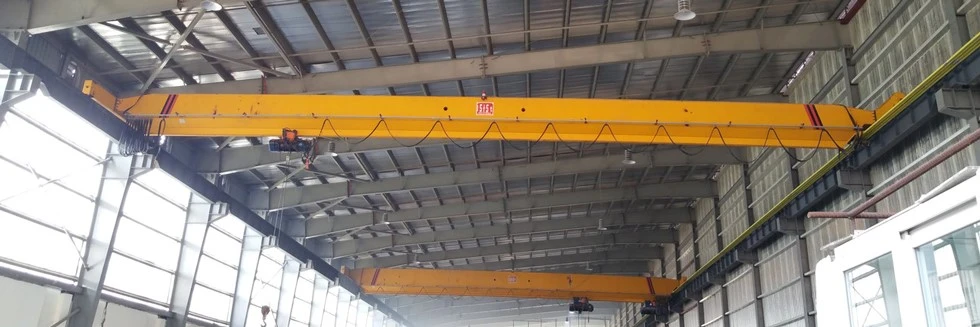
(13) It is not allowed to throw things from the car casually.
(14) Limit switches and interlock protection devices should be checked frequently.
(15) It is not allowed to use the limit switch as a way to stop.
(16) When there is a problem with the lifting brake, it is not allowed to lift heavy objects.
(17) The hoisted objects are not allowed to run over people or equipment.
(18) When welding a certain part of the crane, it is necessary to specially set up the ground wire, and it is not allowed to use the fuselage as the ground wire.
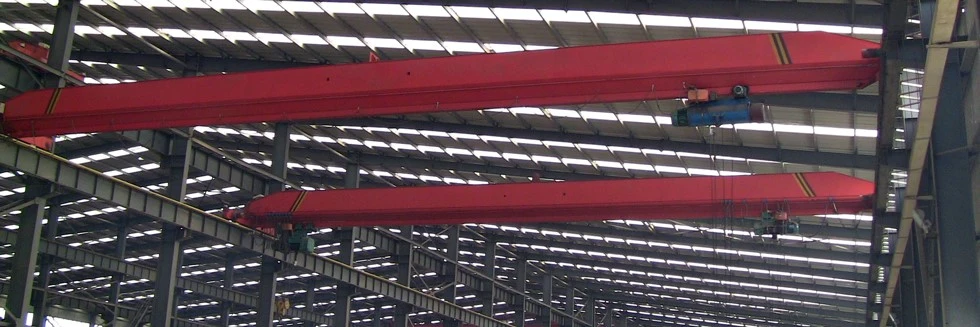
(19) When the hook is at the lower limit position, there must be more than two safety rope loops on the reel.
(20) Cranes are not allowed to collide with each other, and it is not allowed to use one crane to push another crane to work.
(21) When lifting heavy objects, liquid metal, explosive and dangerous goods, it must be lifted slowly 100~200mm from the ground to test the reliability of the brake.
(22) The voltage of the lighting lamps used for repair and inspection must be below 36V.
(23) All electrical equipment shells of bridge cranes should be grounded. If the trolley track is not welded on the main beam, measures should be taken to weld the ground wire. The ground wire can be galvanized flat iron with a cross-sectional area greater than 75mm2 or bare copper wire with a cross-sectional area of 10mm2 or galvanized round steel with a cross-sectional area greater than 30mm2. There should be more than two grounding locations for the driver's cab or crane body. The grounding resistance between any point on the crane and the neutral point of the power supply should be less than 4Ω.
(24) It is necessary to conduct regular safety technical inspections and do a good job in pre-inspection and pre-repair work.


